
You ask most people who sings their favorite songs about New York, and the answers likely say more about the ages of those answering than it does the subject of the question. My kids, for example, would almost certain answer Jay Z and Alicia Keys (“Empire State of Mind”); my wife would likely tell you Billy Joel (“New York State of Mind” or even “Scenes From an Italian Restaurant”); and my parents’ generation would crack a reminiscent smile before saying Ol’ Blue Eyes (“New York, New York”) or Paul Simon (take your pick of the catalog: “Only Living Boy in New York,” “59th Street Bridge Song,” etc).
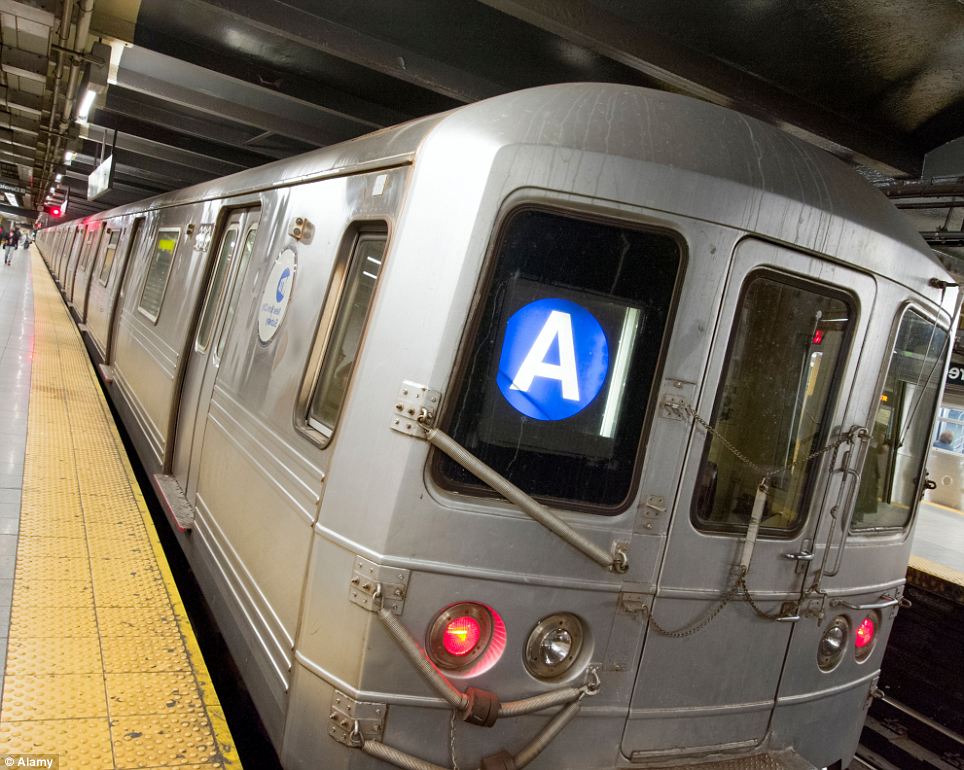
The inspiration for Duke Ellington’s “Take the ‘A’ Train”
To find my answer to the question, we must travel back a bit further in time, to the pre-War era, my grandparents’ generation. For me, the answer is a function entirely of my fondness for The City, for the things that make NYC both intimidating and exhilarating all at once — the densely packed skyscrapers, the throngs of humanity, the miles and miles of pavement in every direction, the endless and near-exhausting dining and entertainment options, just to name a few. Topping that list, however, is the one thing that scares most visitors silly about The Big Apple, the thing that most makes me love it: The Subway. Yes, I absolutely LOVE the New York subway system. I love the freedom it gives me to move around, among and beneath the most impressive city on earth. I love the eclectic and comprehensive sampling of humanity it thrusts together. I love the challenge it presents each and every time I use it in figuring out which stairwell to descend, which platform to stand on and, ultimately, which train to board. For me, the subway perfectly encapsulates all that is New York. And, as a result, I can’t so much as think about The City, let alone visit it, without the melody of Duke Ellington’s “Take the ‘A’ Train” humming through my head.
The NYC Subway can be intimidating to the newcomer, to be sure, but its mystery and mystique are pretty easily stripped away with a just bit of preparation beforehand, a good map (or mobile app) in your palm on arrival, and a level head on your shoulders as you ride. There really are only two keys to solving NYC’s underground puzzle: (1) Do your homework before you go, and (2) have fun with it while you’re there.
A Geography Lesson: The Outer Boroughs, and Uptown vs. Down
I find that most visitors have at least some familiarity with New York, but few (beyond those who visit often) have any real appreciation that The City extends far beyond the island of Manhattan, which of course is world famous for its skyscrapers (the Empire State and Chrysler buildings, the new World Trade Center tower), its vast Central Park, Wall Street, Times Square, Grand Central Station and Madison Square Garden, and of course that shoppers’ paradise, 5th Avenue. Before one can hope to tackle the NY subway with any grace, it is imperative to understand the five-borough structure of the place. (Okay, for purposes of the subway, knowing four boroughs will do.) The City that is New York actually encompasses two full islands (Manhattan and Staten), the western tip of a third (Long Island, or, as they say up there, Lohn-GUY-land), and a small piece of the mainland mass that quickly gives way to that forgotten part of the larger New York … so-called “Upstate” (aka, “Everything That Isn’t New York City”).
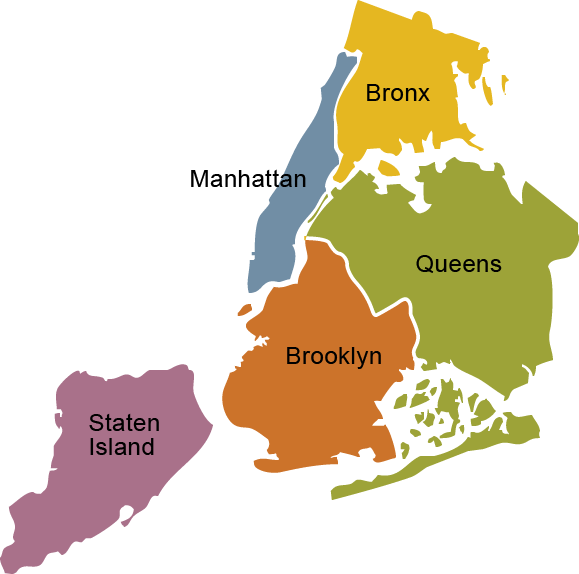
The Five Boroughs of New York City
A quick peek at a colorful map makes quite obvious that the part everyone knows, Manhattan Island, is actually the least of the pieces in a much-greater whole (in terms of landmass, that is). Brooklyn and Queens to the east, which sit on the western tip of Long Island, dwarf Manhattan by comparison. The Bronx to the north, known mostly for high crime and the New York Yankees (which in some years may well be one and the same), appears to be eating Manhattan for dinner. And Staten Island (aka, “The Forgotten Borough”), which clearly keeps its distance to the south, is home to thousands upon thousands of mostly blue-collar, semi-urban households.
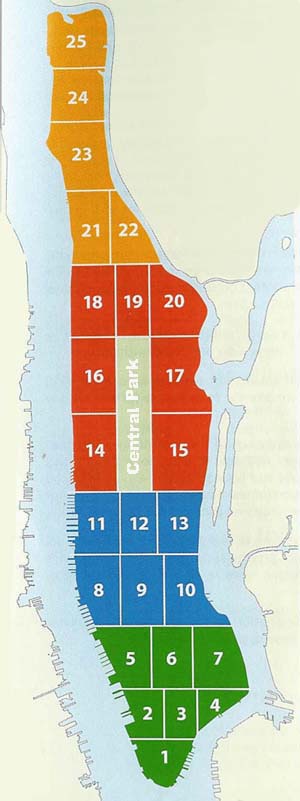
Understanding “Uptown” and “Dowtown” is easy with the right visual aid
But despite its diminutive size, Manhattan does get the lion’s share of attention, and, on any given day, it also moves the lion’s share of humanity. And by any Manhattanite’s standards, it is always overrun with visitors of two types: (a) the touristy kind, and (b) the “B&T” trashy kind (that is, those “less refined” souls who often file in over the bridges and through the tunnels from Jersey and the outer boroughs; think Snooky and The Situation). And thus anyone and just about everyone who rides the NY subway must understand the two most fundamental divisions of the Manhattan Island — Uptown vs. Downtown. “Downtown” Manhattan — the lower quarter of the island (the green part “down” at the bottom of the map to the right) — is known for the world’s most powerful financial district (Wall Street) and its eclectic, often bohemian, neighborhoods. “Uptown” Manhattan — the red part “up” around Central Park (see how that works?) — is known largely for its upscale lifestyle (think Park Avenue and the Waldorf Astoria). [The blue bit in the middle, “Midtown,” is popular as well, known for Broadway shows, Rockefeller Center, and the circus that is Times Square, among other things; while the yellow at the very top (Harlem and Washington Heights) is, for the tourist, a no-man’s land, typically not to be explored.] The Uptown-Downtown dichotomy is visible in just about every aspect of New York City life, and, for the island of Manhattan, it lies at the very heart of its underground transportation system.
The Trains: Which way do they go?
For purposes of this discussion, this lesson in geography is important for one very simple reason: You shouldn’t board a train unless you know where it’s going. You, as a visitor, almost certainly won’t be riding that train to its final destination, but when you’re standing on the platform and the train comes rumbling into the station, it’s awfully comforting to know, before stepping aboard, that the terminus displayed atop the first car you see matches that for the train you expected to ride. Even when traveling just a few stops in central Manhattan, knowing the train’s terminal station can save you the frustration of boarding the local train when you wanted the express, or vice versa (more on that later). And when you venture out towards the ends of Manhattan (which you will do if you’re really seeing the city), understanding that not all trains on the track head to the same place is imperative.
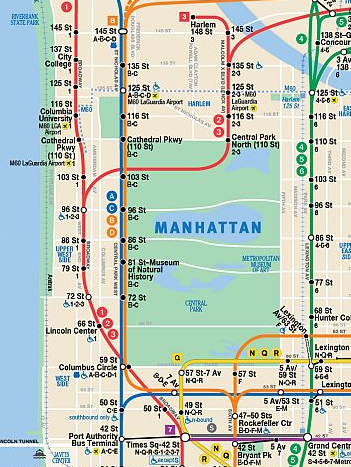
Same track, same markings, different destinations
For example, let’s say you’ve just had lunch near the 72nd Street Station on NY’s Upper West Side (UWS for short), and you’d like to pay a quick visit to a certain Ivy League Campus, that of Columbia University, a couple of miles to the north. The first thing you need to know (which you will, because you’ve done your homework and read this article in its entirety), is that you should follow signs to the 1-2-3 lines (the red line with red circles bearing the numbers 1, 2 & 3 in the map to the left). You’ll also need to know (which you will) that you want to take an uptown train (seeing as how the trip from 72nd Street to Columbia/116th St takes you upward on the map). But what’s most important is this: The platform on which you’ll board the train has three separate lines running through it — the 1-line, the 2-line and the 3-line — the trains for which all bear circles of equal shape and color on the front. But all trains are not created equal, for if you hop on the car that comes to rest in front of you, and that car is part of a 2-train or a 3-train, you’ll find yourself headed not to the quirky collection of colleges and universities that is Morningside Heights, but instead to a quite different place altogether — to the rough & tumble neighborhood known as Harlem (3-train), or the equally rough & tumble borough that is “The Bronx” (2-train). Neither of these is a mistake you can’t correct, but they do ensure a longer and perhaps much more adventurous ride than you’d originally had in mind.
In short, I’ve given you, so far, two bits of wisdom that will ensure your relationship with the NYC Subway has a chance to succeed. Rule #1: Know your Brooklyn from your Queens and your Up from your Down. And Rule #2 (which is like unto it): Know, before you board, which train is going where.
There’s still much more to go, but at this point you have plenty to digest, and no doubt you’re itching to start your Google search for “The Five Boroughs” and dive into the NYC map. And so, for now, I’ll bid adieu with those three words that all TV fans just love to see:
… TO BE CONTINUED
~ JD
(Cover photo: My son, Philip, descending Mt. Meru, Tanzania, in the glow of early dawn, with the slopes of Mt. Kilimanjaro looming in the distance.)
 WanderLuster
New York, New York, a helluva town. The Bronx is up and the Battery’s down. The people ride in a hole in the ground.
Great addition, Tim. Thank you!
Good post!!! I’ve been taking the A train for 20 years to work and back! 🙂 I have had so many adventures there that I am thinking of writing a blog dedicated to that alone! 🙂
Why, thank you, Trekker. And what a fascinating travel blog you have going. Having had the passport stamped in 18 foreign countries myself, your blog is right on point for me. Thanks for reaching out.
I learned late how to use the subway… after having missed 2 different flights due to traffic.
Which is funny because the local mode of transport has always been the way to go everywhere else in the world!
Love this city! enjoy every time I am here.