
Previously, on WanderLuster: “Who sings your favorite song about New York? (Jay-Z) Mehhh! (Billy Joel) Mehhh! (Frank Sinatra; Paul Simon) Mehhh! Mehhh!!! Why, Duke Ellington, of course. … You have to know your in from your out, your up from your down — Manhattan’s here; Brooklyn & Queens are over there; Bronx is up there; Staten Island is, well, Staten Island. … ‘How do I know which train to board?’ Easy. Know where you’re going; know where the train’s going.”
I think that pretty much covers Part 1. And now, as Mr. Harvey used to say, the rest of the story.
Choosing The Right Station in Manhattan: Local vs. Express
At this point I’ll assume you’ve taken a gander at the map and can, at the very least, figure out which lines — A-C-E, 1-2-3, B-D-F, 4-5-6, J-Z (yes, that Jay-Z; you think it coincidence he owns half of Brooklyn?) — run through your Point A and Point B. And of course you’re aware that not all trains on the same track run to the same destination. But if you’re doing your best impersonation of a Manhattanite and avoiding the outer boroughs like The Plague, once you’ve picked a line in your favorite color, it doesn’t matter which train you board, right? … Mehhh!!!
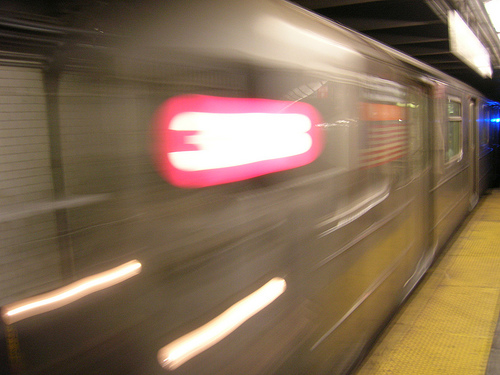
The 3-train. Express indeed!
Even within the narrow subterranean confines of Central Manhattan, not all trains of equal color are created equal. You won’t ride the New York subway long before you have the obligatory newcomer’s “WTF?” moment: Standing on the platform at Lincoln Center, glowing with pride that you found your way there with minimal effort, and half-stricken with fear that any guy in a coat is looking to mug you, you hear the rumble, rumble, rumble of the approaching train in the tunnel; your heart quickens with excitement as you spot the large red number “3” in the distance, and you edge just a smidge over the yellow line and crane your neck to watch it pull into the station. But in an instant you get this odd feeling as your brain sends out an alarm — the train’s not slowing down; it’s not slowing at all; and then, right before your eyes, as if conjured by magic, the two pairs of tracks (one uptown, one down) that had been before you all along are suddenly four; and (you’ll be damned!) that 3-train you wanted isn’t stopping here at all; and even if it did it would do you no good — there’s a good 30-foot gap separating you from the train as it goes flying by. W? T? F?
Welcome to Manhattan. You just met your first express train.
That’s right, The Express. Your best friend, or your worst nightmare, depending on where you need to go and how long you have to get there. You see, no matter what they might do in the outer boroughs — from Bedford Park in Bronx to Brighton Beach in Brooklyn (the B-train), or from Forest Hills, Queens, to Coney Island (the F-train) — two trains of the same color, though sharing the same tracks and hitting the same stations, do not necessarily share all the same stops in Central Manhattan. This tidbit of information is very good to know before you go underground, especially when you have just 20 minutes to get from the Upper West Side to Greenwich Village and you see nothing but brake lights heading south on 9th Avenue.

The 1-2-3 trains serve Lincoln Center on the Upper West Side … or do they?
Let’s return to the scene at Lincoln Center — you standing on the platform, map in hand, dazed look on your face, hair tousled by the minor windstorm the 3-train left in its wake — to assess what you did wrong. On first glance at your map (see right), your confusion only compounds as you notice the three large red circles labeled “1,” “2” and “3” sitting right beside the red-colored line at the 66th St. / Lincoln Center station. “Why on earth didn’t that 3-train stop!?!” And then you see it, and it becomes so obvious as its meaning sinks in. Right next to the little blue guy in the little blue wheel chair. That black number “1,” there all by itself. Yet just above it, at the map entry for 72nd St. Station, the “1” is accompanied by two other numbers — the “2” and the “3.” And then you notice that Lincoln Center is marked by a solid black dot, while the dot for 72nd Street is white encircled with black. Scrolling down the map, you notice this elsewhere too — all the solid black dots on the red line (Columbus Circle; 50th St.; 28th, 23rd and 18th Streets) are accompanied by the number “1” only, while all the white dots (Times Square; 34th St.; 14th St.) also bear the “2” and “3.” Could this mean …? Yes, it does. The 1-train (aka, the “local”) stops at every single station along the red line in Manhattan, while the 2- and 3-trains (you guessed it … the “express” trains) stop only every few stations.
The same is true with the other lines as well. Both the A-train and C-train, for example, stop at Columbus Circle (at the southwest corner of the great Central Park), 42nd St., Penn Station, and 14th St., but only the E-train (the local train) stops at the 72nd, 50th and 23rd Street stations. If your destination is a local-only station somewhere down the line, then your best bet is probably to make your way to the nearest station for that line and hop on the local train (or take the express train to the last express stop before your destination and then switch to the local train there). But if you want to avoid the delays (sometimes lengthy) that the local trains bring, you’re quite often better walking a little bit further to a station where you can catch the express train. It’s really not nearly as tricky as it sounds. Just know — and use! — your map.
The Platforms: Measure Twice, Descend Once
In my (very) amateur opinion, the toughest challenge, by far, in navigating the NY subway is figuring out, from street level, where and how to descend. At many, if not most, Manhattan street corners that give access to the subway, you’ll find more than one point of entry into the belly of the underground beast. Choose the wrong portal, and you’ll find yourself standing on the “bad” side of the tracks, waiting for an uptown train when you want to go down. You’ll see all the other downtown-bound passengers standing just there, barely 30 feet away on the opposite platform, so tantalizingly close. But alas (you’ll soon learn), the only way to join them is to retrace your steps, back through the turnstile and up the stairs, to surface level, then across a busy thoroughfare — sometimes two to get to the opposite corner — where you’ll descend again, swiping your Metrocard a second time (and forking over another fare) just in time to watch your downtown train close its doors and leave the station right before your eyes.
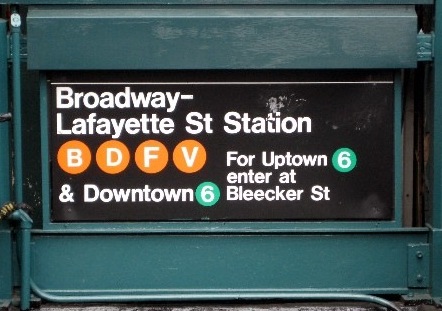
The uptown 6-train? Won’t find it here.
At many intersections, such as 72nd Street and Broadway on the Upper West Side, you’re free to choose any of the entrances as your point of descent — overhead signs will guide you cleverly to the proper platform for the proper line once you’ve removed yourself from the noisy scene above. But in other places — such as at the corner of Houston (pronounced “HOUSE-ton,” for all you Texans out there) and Broadway, where Soho meets The Village — you’ll find signs like the one to the left, pointing you down the stairs if it’s the downtown 6-train you seek, and directing you to another intersection altogether, some 2-1/2 blocks away, if it’s the uptown train you’re after. Let’s be clear — a scene like this one is more than just slightly intimidating. Enough to make some people throw in the towel altogether. But for me, these little surprises are all part of the fun, giving me reason to stop and collect my wits, pull out my map to plot the right course, and set out on yet another micro-journey within the greater adventure that draws me to The City in the first place.
And when you reach your destination station, you’ll likely be confronted with a decision again: Do you want 7th Avenue or 8th? The northeast corner of the intersection, or the southwest? The keys to mastering the platforms, and your descents and ascents to and from them, are a good map and a reliable sense of direction, plus a little preparation before you start your journey. As long as you know your up from your down and your east from your west (and, yes, even that is put to the test in a forest with a skyscraper canopy over a concrete floor) and you pause long enough to steady your pulse and gather your bearings, and assuming you take time to read and follow the directions the signage is giving you, you’ll find your way to the right location almost every time with minimal frustration and delay. But know this as well, and prepare yourself accordingly: No matter how right you get it, you will, quite often, arrive just in time to see your train waving its derriere mockingly at you.
Changing Trains: Navigating the Labyrinth on Foot
It won’t happen terribly often, and for your first visit or two it might not happen at all, but spend much time in NYC, and at some point you’ll need to change trains en-route. Doing so is no great challenge once you’ve mastered the trick of finding the right train to begin with — know which line you want and which way you’re going, then follow the overhead signs — but it is a skill that requires just a slightly deeper understanding of the structure of the subway system.
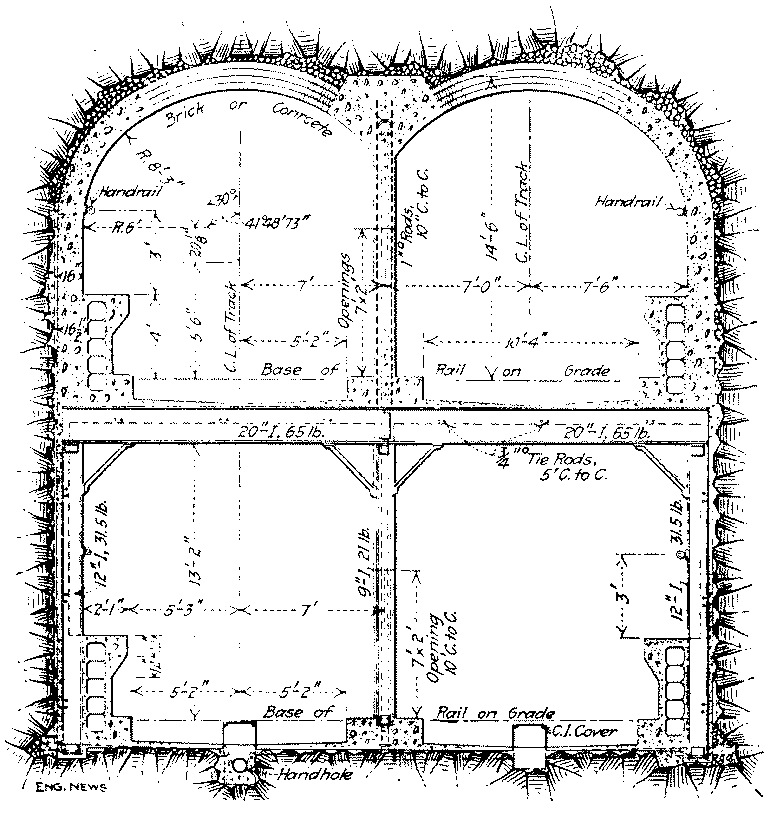
When two lines share a route, someone’s gotta be on top
To the right is a turn-of-the-century (not this century, the last century) cross-sectional drawing of two subway lines running along Lexington Avenue on Manhattan’s east side. For some reason, for me it’s easy to visualize a single line — with one uptown and one downtown set of tracks — dug through the earth beneath the asphalt grid above, but it’s much more difficult to picture the subway for the multi-layered maze that it really is, with tracks running under tracks, sometimes in parallel (as shown to the right) and sometimes not. Where two lines pull into a station one above the other or side-by-side, navigating between them is a pretty easy chore — you’ll typically go up or down a set of stairs or an escalator or two, occasionally crossing under or over the trains above or below to get to the proper uptown-downtown, inbound-outbound platform. But the distance you’ll travel is relatively short, and as you’re doing it, the multi-level structure of the station becomes a bit clearer.
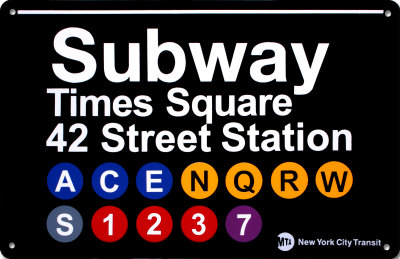
Times Square / 42nd Street Station
But consider a “station” like 42nd St / Times Square, which allows you to catch any one of eleven trains (twelve at one point not too long ago) running through it. That’s ELEVEN trains (A-C-E, N-Q-R, 1-2-3 and 7, plus the 42nd St. “S” shuttle) on five separate lines, with service in every direction to just about every nook and cranny of the four boroughs that receive it. How in earth can so many trains pass through a single station? Is 42nd Street a 30-story subterranean “low”-rise?
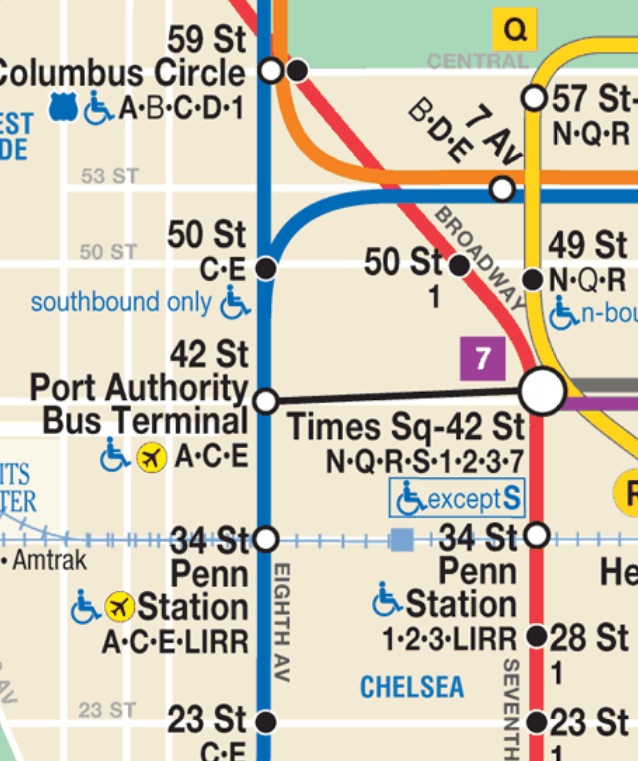
42nd Street is one loooooong station
The map-snippet to the right makes some sense of it all. While 42nd Street Station is a monstrosity that hosts quite a confluence of rail-borne travelers, it is known as much (if not more) for its girth than its depth and, in fact, stretches for more than a full crosstown block (one of the longest blocks in Manhattan at that!) between 7th and 8th Avenues. The A-C-E trains hit 42nd Street Station along 8th Avenue to the west. The 1-2-3 trains follow the criss-cross trajectory of Broadway to and from the Upper West Side on the north side of the station and track 7th Avenue to the south. The N-Q-R trains make a giant westward sweep through Midtown for the sole purpose of intercepting 42nd Street passengers before darting back to their more easterly destinations.
What the map doesn’t make clear is the amount of exercise you’ll get when “hopping” from the N-Q-R or 7 lines to the A-C-E line at 42nd Street. Along with the series of twists, turns and ascents and descents you’ll make during that transfer, you’ll also get a good 10-15 minute walk in, or more if you’re moving at a less-than-decent clip.
And, of course, any change of trains means that, once you’ve maneuvered your way to the right platform, you play the waiting game all over again, enjoying the sights, sounds and smells of the Manhattan underworld until that next train arrives. As with any other subway-navigation skill, knowing where you’re going and following directions are key, and that’s generally simple enough. But when your route calls for a transfer between lines, be sure you leave ample time for the extra navigation and double-wide wait you’ll encounter.
The Metro Card: On Second Thought, Maybe Scoring A Ticket Is The Hardest Part
My prior thoughts notwithstanding, getting through the turnstiles just might be the toughest challenge the subway presents. I’ve decide that those “crooks” who hop the stiles don’t do so to save a few bucks; they do it to save themselves the hassle. With few exceptions, every trip on an MTA vehicle (no matter how short or how far you travel) costs two-dollah, fiddy-cent. Access requires a MetroCard, which acts as a debit card to which you apply funds and then deplete as you pass through the stiles.
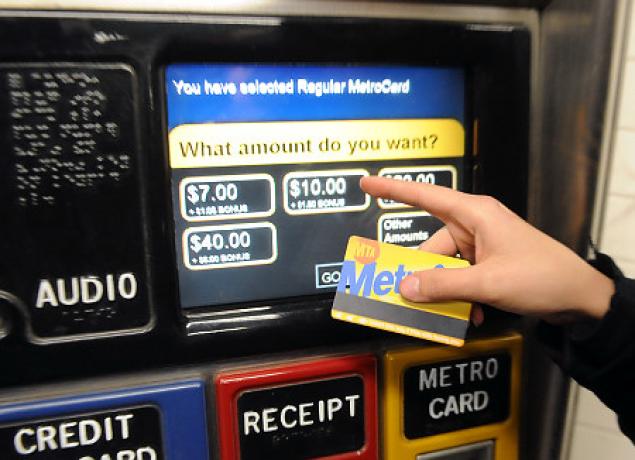
NYC’s most daunting task?
Navigating the self-service machines that distribute the cards is tricky in and of itself, especially when you’re approaching one for the first time. Start by telling it what language you speak (presumably English will do since you’ve made it this far in my story). Then tell it whether you’re purchasing a new card or topping off an old one (saving your used card and refilling it later saves you a dollar each time you use the machines), and tell it how much money you want to add. The machines typically add some amount of bonus (e.g., $1.05 extra on a $10 card) that gets larger the more money you add. You then tell the machine how you want to pay, insert your method of payment, and take the card as the machine spits it out. If you’re staying more than two or three days or you anticipate heavy use of the MTA system, consider buying a multi-day pass, which allows unlimited rides for a limited period of time at a flat-fee (currently $30 for seven days).
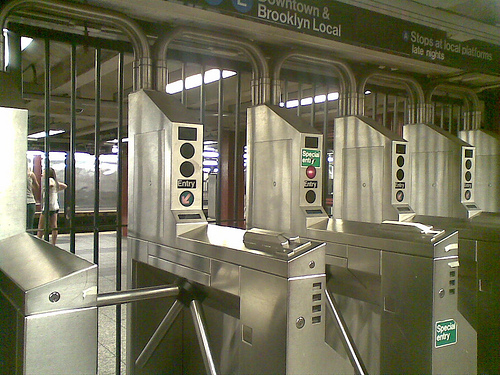
A simple process, a fickle steward
Once you’ve finally passed the MTA’s do-it-yourself product-purchase test, you’re ready to tackle the turnstiles. In theory, this is a very simple process: Approach a stile that says “Entry” (as opposed to “Exit”), swipe your card through the reader (with the magnetic strip facing the right way, of course, a puzzle that most stiles leave to you to decipher), and walk on through. In reality, each stile has a brain of its own, and quite often the inner workings of that brain defy explanation and require patience on your part. Most of the time (if you’re lucky), one swipe will do the trick and you’ll be on your merry way. On occasion, though, the stile wants a second look (no one’s ever been able to explain to me why), and, on some of those occasions, it decides (for reasons of its very own) that you need to pay twice. I must concede that this side of the subway frustrates me no-end, but I just chalk it up to the cost of doing business, or of having fun, or of being an outsider (let’s call it the “tourist tax”). Whatever mood the turnstile is in, don’t let it win the battle. Keep your cool, do what its 80’s-era LED display tells you to do, and carry on with your day. My money says that the extra $2.50 you donate to the economy there is just a tiny fraction of your total donation that day, and it’s likely no more than the tip you’d leave on each of the $20 cab rides you’d be taking had you chosen not to ride the subway in the first place.
Parting Shots
I’ll leave you with a few do’s and don’ts, with minimal explanation. Best you just follow them. Or don’t — we’ll all enjoy hearing the stories that result.
- If the car is empty, don’t get in it! It’s empty for a reason. A very foul reason.
- Paper maps are fine, mobile apps divine. Get one.
- That mobile app (or map): Do your best to use it up above, at street level, discretely, as you sit at the lunch table or duck into a coffee shop. Use it quietly on the train as you ride to your destination, double-, triple-, even quadruple-checking your route and your exit strategy. Try your damnedest NOT to use it while standing in the station or on the platform. And keep in mind that the more of you who are huddled around it, the fatter a target you become.
- Don’t announce your travel plans, or any part of them, loudly to your fellow travelers. A soft voice will do (and will be covered nicely by the rumble of the train) for those who really need to hear what you need them to hear.
- Hold onto your stuff. Ladies, keep your bags in your laps. Gents, keep your bags in your laps. Travel with a thin wallet and keep it in your front pocket. Or in your bag. I’ve never been picked on the train, and let’s make sure you aren’t either.
Now you’re ready to tackle New York City and its favorite mode of transportation. So get thee to the Bowery, ride the train there, and have fun doing it!
~ JD
(Cover photo: My son, Philip, descending Mt. Meru, Tanzania, in the glow of early dawn, with the slopes of Mt. Kilimanjaro looming in the distance.)
 WanderLuster
I have missed 2 different flights home from NYC by “treating” myself to a taxi. Both time by just minutes! Never more! I am not as adept at the subway and trains as I should be, and will reread more carefully before I head back to the Big Apple. Few things more frustrating than wasting time and money in a taxi- spending an hour to go cross town…
Thanks JD.