And return on the “E” train

Previously, on WanderLuster:  “Who sings your favorite song about New York? (Jay-Z) Mehhh! (Billy Joel) Mehhh! (Frank Sinatra; Paul Simon) Mehhh! Mehhh!!! Why, Duke Ellington, of course. … You have to know your in from your out, your up from your down — Manhattan’s here; Brooklyn & Queens are over there; Bronx is up there; Staten Island is, well, Staten Island. … ‘How do I know which train to board?’ Easy. Know where you’re going; know where the train’s going.”

I think that pretty much covers Part 1. And now, as Mr. Harvey used to say, the rest of the story.

Choosing The Right Station in Manhattan: Local vs. Express

At this point I’ll assume you’ve taken a gander at the map and can, at the very least, figure out which lines — A-C-E, 1-2-3, B-D-F, 4-5-6, J-Z (yes, that Jay-Z; you think it coincidence he owns half of Brooklyn?) — run through your Point A and Point B. And of course you’re aware that not all trains on the same track run to the same destination. But if you’re doing your best impersonation of a Manhattanite and avoiding the outer boroughs like The Plague, once you’ve picked a line in your favorite color, it doesn’t matter which train you board, right? … Mehhh!!!

The 3-train. Express indeed!

Even within the narrow subterranean confines of Central Manhattan, not all trains of equal color are created equal. You won’t ride the New York subway long before you have the obligatory newcomer’s “WTF?” moment: Standing on the platform at Lincoln Center, glowing with pride that you found your way there with minimal effort, and half-stricken with fear that any guy in a coat is looking to mug you, you hear the rumble, rumble, rumble of the approaching train in the tunnel; your heart quickens with excitement as you spot the large red number “3” in the distance, and you edge just a smidge over the yellow line and crane your neck to watch it pull into the station. But in an instant you get this odd feeling as your brain sends out an alarm — the train’s not slowing down; it’s not slowing at all; and then, right before your eyes, as if conjured by magic, the two pairs of tracks (one uptown, one down) that had been before you all along are suddenly four; and (you’ll be damned!) that 3-train you wanted isn’t stopping here at all; and even if it did it would do you no good — there’s a good 30-foot gap separating you from the train as it goes flying by. W? T? F?

Welcome to Manhattan. You just met your first express train. 

That’s right, The Express. Your best friend, or your worst nightmare, depending on where you need to go and how long you have to get there. You see, no matter what they might do in the outer boroughs — from Bedford Park in Bronx to Brighton Beach in Brooklyn (the B-train), or from Forest Hills, Queens, to Coney Island (the F-train) — two trains of the same color, though sharing the same tracks and hitting the same stations, do not necessarily share all the same stops in Central Manhattan. This tidbit of information is very good to know before you go underground, especially when you have just 20 minutes to get from the Upper West Side to Greenwich Village and you see nothing but brake lights heading south on 9th Avenue.

01 - NYC Subway - Central Manhattan

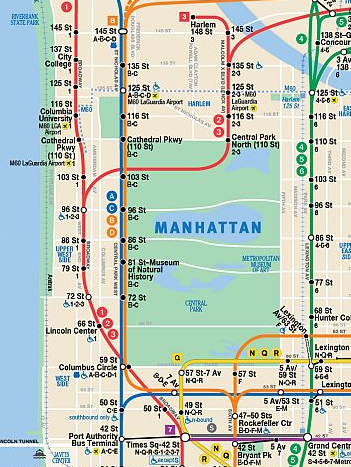
The 1-2-3 trains serve Lincoln Center on the Upper West Side … or do they?

Let’s return to the scene at Lincoln Center — you standing on the platform, map in hand, dazed look on your face, hair tousled by the minor windstorm the 3-train left in its wake — to assess what you did wrong. On first glance at your map (see right), your confusion only compounds as you notice the three large red circles labeled “1,” “2” and “3” sitting right beside the red-colored line at the 66th St. / Lincoln Center station. “Why on earth didn’t that 3-train stop!?!” And then you see it, and it becomes so obvious as its meaning sinks in. Right next to the little blue guy in the little blue wheel chair. That black number “1,” there all by itself. Yet just above it, at the map entry for 72nd St. Station, the “1” is accompanied by two other numbers — the “2” and the “3.” And then you notice that Lincoln Center is marked by a solid black dot, while the dot for 72nd Street is white encircled with black. Scrolling down the map, you notice this elsewhere too — all the solid black dots on the red line (Columbus Circle; 50th St.; 28th, 23rd and 18th Streets) are accompanied by the number “1” only, while all the white dots (Times Square; 34th St.; 14th St.) also bear the “2” and “3.” Could this mean …? Yes, it does. The 1-train (aka, the “local”) stops at every single station along the red line in Manhattan, while the 2- and 3-trains (you guessed it … the “express” trains) stop only every few stations.

The same is true with the other lines as well. Both the A-train and C-train, for example, stop at Columbus Circle (at the southwest corner of the great Central Park), 42nd St., Penn Station, and 14th St., but only the E-train (the local train) stops at the 72nd, 50th and 23rd Street stations. If your destination is a local-only station somewhere down the line, then your best bet is probably to make your way to the nearest station for that line and hop on the local train (or take the express train to the last express stop before your destination and then switch to the local train there). But if you want to avoid the delays (sometimes lengthy) that the local trains bring, you’re quite often better walking a little bit further to a station where you can catch the express train. It’s really not nearly as tricky as it sounds. Just know — and use! — your map.

The Platforms: Measure Twice, Descend Once

In my (very) amateur opinion, the toughest challenge, by far, in navigating the NY subway is figuring out, from street level, where and how to descend. At many, if not most, Manhattan street corners that give access to the subway, you’ll find more than one point of entry into the belly of the underground beast. Choose the wrong portal, and you’ll find yourself standing on the “bad” side of the tracks, waiting for an uptown train when you want to go down. You’ll see all the other downtown-bound passengers standing just there, barely 30 feet away on the opposite platform, so tantalizingly close. But alas (you’ll soon learn), the only way to join them is to retrace your steps, back through the turnstile and up the stairs, to surface level, then across a busy thoroughfare — sometimes two to get to the opposite corner — where you’ll descend again, swiping your Metrocard a second time (and forking over another fare) just in time to watch your downtown train close its doors and leave the station right before your eyes.
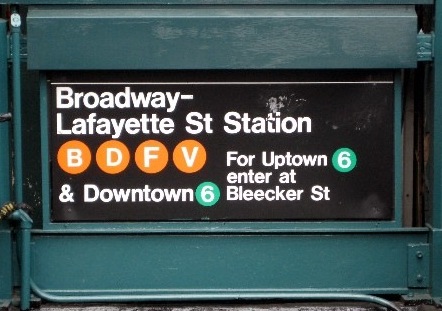
02 - Broadway-Lafayette Station

The uptown 6-train? Won’t find it here.

At many intersections, such as 72nd Street and Broadway on the Upper West Side, you’re free to choose any of the entrances as your point of descent — overhead signs will guide you cleverly to the proper platform for the proper line once you’ve removed yourself from the noisy scene above. But in other places — such as at the corner of Houston (pronounced “HOUSE-ton,” for all you Texans out there) and Broadway, where Soho meets The Village — you’ll find signs like the one to the left, pointing you down the stairs if it’s the downtown 6-train you seek, and directing you to another intersection altogether, some 2-1/2 blocks away, if it’s the uptown train you’re after. Let’s be clear — a scene like this one is more than just slightly intimidating. Enough to make some people throw in the towel altogether. But for me, these little surprises are all part of the fun, giving me reason to stop and collect my wits, pull out my map to plot the right course, and set out on yet another micro-journey within the greater adventure that draws me to The City in the first place.

And when you reach your destination station, you’ll likely be confronted with a decision again: Do you want 7th Avenue or 8th? The northeast corner of the intersection, or the southwest? The keys to mastering the platforms, and your descents and ascents to and from them, are a good map and a reliable sense of direction, plus a little preparation before you start your journey. As long as you know your up from your down and your east from your west (and, yes, even that is put to the test in a forest with a skyscraper canopy over a concrete floor) and you pause long enough to steady your pulse and gather your bearings, and assuming you take time to read and follow the directions the signage is giving you, you’ll find your way to the right location almost every time with minimal frustration and delay. But know this as well, and prepare yourself accordingly: No matter how right you get it, you will, quite often, arrive just in time to see your train waving its derriere mockingly at you.

Changing Trains: Navigating the Labyrinth on Foot

It won’t happen terribly often, and for your first visit or two it might not happen at all, but spend much time in NYC, and at some point you’ll need to change trains en-route. Doing so is no great challenge once you’ve mastered the trick of finding the right train to begin with — know which line you want and which way you’re going, then follow the overhead signs — but it is a skill that requires just a slightly deeper understanding of the structure of the subway system.
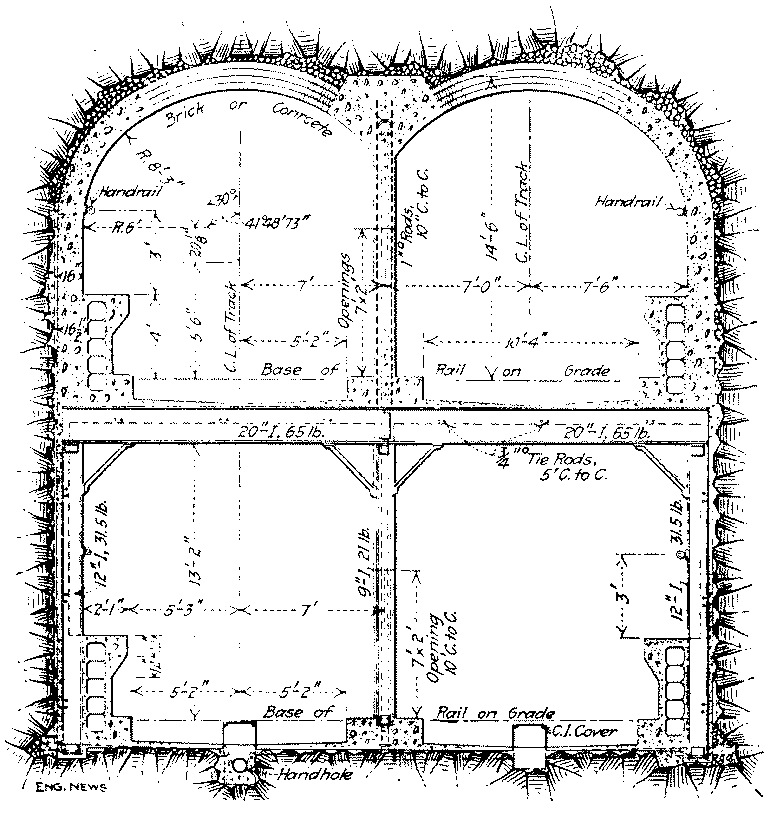
03 - Subway Cross-Section

When two lines share a route, someone’s gotta be on top

To the right is a turn-of-the-century (not this century, the last century) cross-sectional drawing of two subway lines running along Lexington Avenue on Manhattan’s east side. For some reason, for me it’s easy to visualize a single line — with one uptown and one downtown set of tracks — dug through the earth beneath the asphalt grid above, but it’s much more difficult to picture the subway for the multi-layered maze that it really is, with tracks running under tracks, sometimes in parallel (as shown to the right) and sometimes not. Where two lines pull into a station one above the other or side-by-side, navigating between them is a pretty easy chore — you’ll typically go up or down a set of stairs or an escalator or two, occasionally crossing under or over the trains above or below to get to the proper uptown-downtown, inbound-outbound platform. But the distance you’ll travel is relatively short, and as you’re doing it, the multi-level structure of the station becomes a bit clearer.
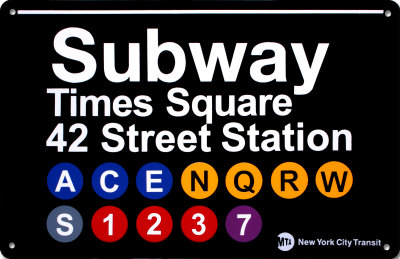
04 - Times Square Station

Times Square / 42nd Street Station

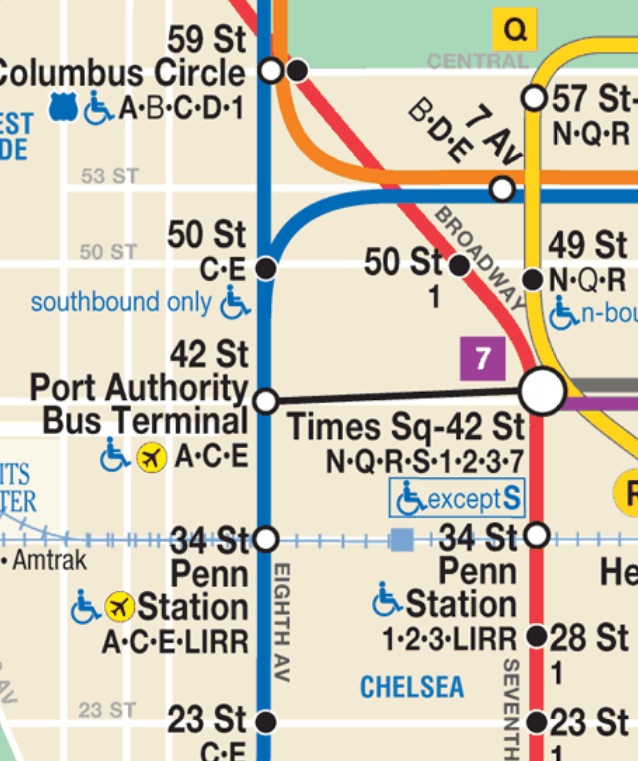
But consider a “station” like 42nd St / Times Square, which allows you to catch any one of eleven trains (twelve at one point not too long ago) running through it. That’s ELEVEN trains (A-C-E, N-Q-R, 1-2-3 and 7, plus the 42nd St. “S” shuttle) on five separate lines, with service in every direction to just about every nook and cranny of the four boroughs that receive it. How in earth can so many trains pass through a single station? Is 42nd Street a 30-story subterranean “low”-rise?
05 - NYC Subway - Times Sq & 42nd St

42nd Street is one loooooong station

The map-snippet to the right makes some sense of it all. While 42nd Street Station is a monstrosity that hosts quite a confluence of rail-borne travelers, it is known as much (if not more) for its girth than its depth and, in fact, stretches for more than a full crosstown block (one of the longest blocks in Manhattan at that!) between 7th and 8th Avenues. The A-C-E trains hit 42nd Street Station along 8th Avenue to the west. The 1-2-3 trains follow the criss-cross trajectory of Broadway to and from the Upper West Side on the north side of the station and track 7th Avenue to the south. The N-Q-R trains make a giant westward sweep through Midtown for the sole purpose of intercepting 42nd Street passengers before darting back to their more easterly destinations.

What the map doesn’t make clear is the amount of exercise you’ll get when “hopping” from the N-Q-R or 7 lines to the A-C-E line at 42nd Street. Along with the series of twists, turns and ascents and descents you’ll make during that transfer, you’ll also get a good 10-15 minute walk in, or more if you’re moving at a less-than-decent clip.

And, of course, any change of trains means that, once you’ve maneuvered your way to the right platform, you play the waiting game all over again, enjoying the sights, sounds and smells of the Manhattan underworld until that next train arrives. As with any other subway-navigation skill, knowing where you’re going and following directions are key, and that’s generally simple enough. But when your route calls for a transfer between lines, be sure you leave ample time for the extra navigation and double-wide wait you’ll encounter.

The Metro Card: On Second Thought, Maybe Scoring A Ticket Is The Hardest Part

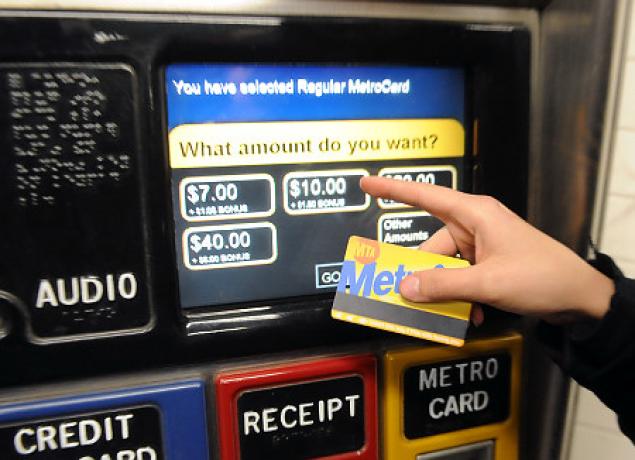
My prior thoughts notwithstanding, getting through the turnstiles just might be the toughest challenge the subway presents. I’ve decide that those “crooks” who hop the stiles don’t do so to save a few bucks; they do it to save themselves the hassle. With few exceptions, every trip on an MTA vehicle (no matter how short or how far you travel) costs two-dollah, fiddy-cent. Access requires a MetroCard, which acts as a debit card to which you apply funds and then deplete as you pass through the stiles.
06 - Metro Card

NYC’s most daunting task?

Navigating the self-service machines that distribute the cards is tricky in and of itself, especially when you’re approaching one for the first time. Start by telling it what language you speak (presumably English will do since you’ve made it this far in my story). Then tell it whether you’re purchasing a new card or topping off an old one (saving your used card and refilling it later saves you a dollar each time you use the machines), and tell it how much money you want to add. The machines typically add some amount of bonus (e.g., $1.05 extra on a $10 card) that gets larger the more money you add. You then tell the machine how you want to pay, insert your method of payment, and take the card as the machine spits it out. If you’re staying more than two or three days or you anticipate heavy use of the MTA system, consider buying a multi-day pass, which allows unlimited rides for a limited period of time at a flat-fee (currently $30 for seven days).
07 - Turnstile

A simple process, a fickle steward

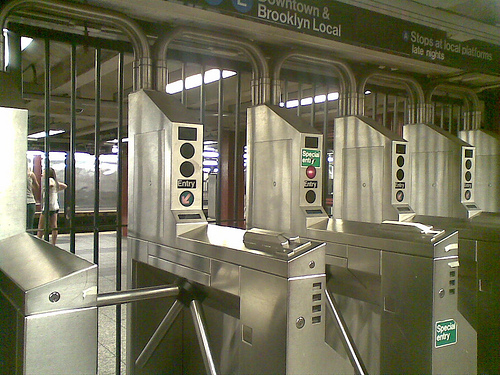
Once you’ve finally passed the MTA’s do-it-yourself product-purchase test, you’re ready to tackle the turnstiles. In theory, this is a very simple process: Approach a stile that says “Entry” (as opposed to “Exit”), swipe your card through the reader (with the magnetic strip facing the right way, of course, a puzzle that most stiles leave to you to decipher), and walk on through. In reality, each stile has a brain of its own, and quite often the inner workings of that brain defy explanation and require patience on your part. Most of the time (if you’re lucky), one swipe will do the trick and you’ll be on your merry way. On occasion, though, the stile wants a second look (no one’s ever been able to explain to me why), and, on some of those occasions, it decides (for reasons of its very own) that you need to pay twice. I must concede that this side of the subway frustrates me no-end, but I just chalk it up to the cost of doing business, or of having fun, or of being an outsider (let’s call it the “tourist tax”). Whatever mood the turnstile is in, don’t let it win the battle. Keep your cool, do what its 80’s-era LED display tells you to do, and carry on with your day. My money says that the extra $2.50 you donate to the economy there is just a tiny fraction of your total donation that day, and it’s likely no more than the tip you’d leave on each of the $20 cab rides you’d be taking had you chosen not to ride the subway in the first place.

Parting Shots

I’ll leave you with a few do’s and don’ts, with minimal explanation. Best you just follow them. Or don’t — we’ll all enjoy hearing the stories that result.

  • If the car is empty, don’t get in it! It’s empty for a reason. A very foul reason.
  • Paper maps are fine, mobile apps divine. Get one.
  • That mobile app (or map): Do your best to use it up above, at street level, discretely, as you sit at the lunch table or duck into a coffee shop. Use it quietly on the train as you ride to your destination, double-, triple-, even quadruple-checking your route and your exit strategy. Try your damnedest NOT to use it while standing in the station or on the platform. And keep in mind that the more of you who are huddled around it, the fatter a target you become.
  • Don’t announce your travel plans, or any part of them, loudly to your fellow travelers. A soft voice will do (and will be covered nicely by the rumble of the train) for those who really need to hear what you need them to hear.
  • Hold onto your stuff. Ladies, keep your bags in your laps. Gents, keep your bags in your laps. Travel with a thin wallet and keep it in your front pocket. Or in your bag. I’ve never been picked on the train, and let’s make sure you aren’t either.

Now you’re ready to tackle New York City and its favorite mode of transportation. So get thee to the Bowery, ride the train there, and have fun doing it!

~ JD

(Cover photo: My son, Philip, descending Mt. Meru, Tanzania, in the glow of early dawn, with the slopes of Mt. Kilimanjaro looming in the distance.)
Take the “A” train

You ask most people who sings their favorite songs about New York, and the answers likely say more about the ages of those answering than it does the subject of the question. My kids, for example, would almost certain answer Jay Z and Alicia Keys (“Empire State of Mind”); my wife would likely tell you Billy Joel (“New York State of Mind” or even “Scenes From an Italian Restaurant”); and my parents’ generation would crack a reminiscent smile before saying Ol’ Blue Eyes (“New York, New York”) or Paul Simon (take your pick of the catalog: “Only Living Boy in New York,” “59th Street Bridge Song,” etc).

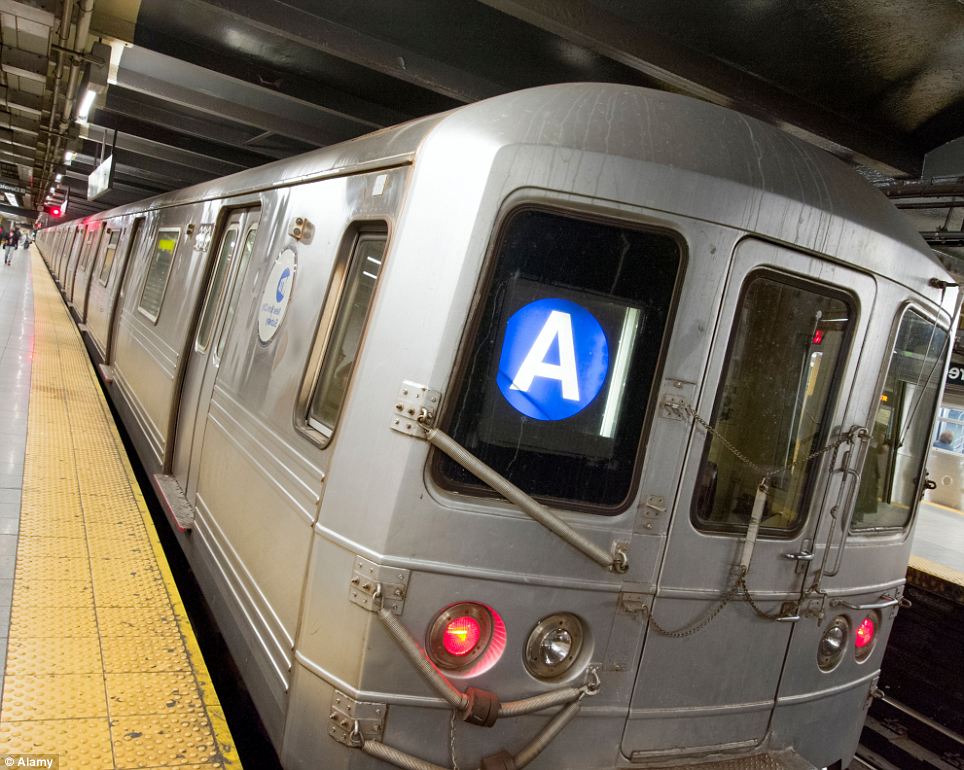
The inspiration for Duke Ellington’s “Take the ‘A’ Train”

To find my answer to the question, we must travel back a bit further in time, to the pre-War era, my grandparents’ generation. For me, the answer is a function entirely of my fondness for The City, for the things that make NYC both intimidating and exhilarating all at once — the densely packed skyscrapers, the throngs of humanity, the miles and miles of pavement in every direction, the endless and near-exhausting dining and entertainment options, just to name a few. Topping that list, however, is the one thing that scares most visitors silly about The Big Apple, the thing that most makes me love it: The Subway. Yes, I absolutely LOVE the New York subway system. I love the freedom it gives me to move around, among and beneath the most impressive city on earth. I love the eclectic and comprehensive sampling of humanity it thrusts together. I love the challenge it presents each and every time I use it in figuring out which stairwell to descend, which platform to stand on and, ultimately, which train to board. For me, the subway perfectly encapsulates all that is New York. And, as a result, I can’t so much as think about The City, let alone visit it, without the melody of Duke Ellington’s “Take the ‘A’ Train” humming through my head.

The NYC Subway can be intimidating to the newcomer, to be sure, but its mystery and mystique are pretty easily stripped away with a just bit of preparation beforehand, a good map (or mobile app) in your palm on arrival, and a level head on your shoulders as you ride. There really are only two keys to solving NYC’s underground puzzle: (1) Do your homework before you go, and (2) have fun with it while you’re there.

A Geography Lesson: The Outer Boroughs, and Uptown vs. Down

I find that most visitors have at least some familiarity with New York, but few (beyond those who visit often) have any real appreciation that The City extends far beyond the island of Manhattan, which of course is world famous for its skyscrapers (the Empire State and Chrysler buildings, the new World Trade Center tower), its vast Central Park, Wall Street, Times Square, Grand Central Station and Madison Square Garden, and of course that shoppers’ paradise, 5th Avenue. Before one can hope to tackle the NY subway with any grace, it is imperative to understand the five-borough structure of the place. (Okay, for purposes of the subway, knowing four boroughs will do.) The City that is New York actually encompasses two full islands (Manhattan and Staten), the western tip of a third (Long Island, or, as they say up there, Lohn-GUY-land), and a small piece of the mainland mass that quickly gives way to that forgotten part of the larger New York … so-called “Upstate” (aka, “Everything That Isn’t New York City”).

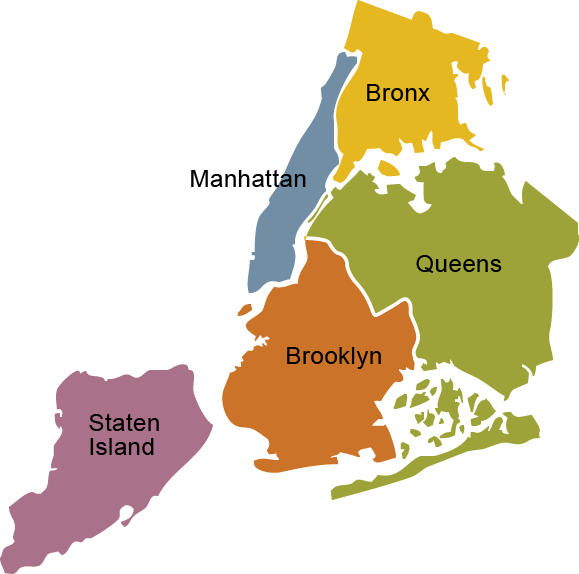
The Five Boroughs of New York City

A quick peek at a colorful map makes quite obvious that the part everyone knows, Manhattan Island, is actually the least of the pieces in a much-greater whole (in terms of landmass, that is). Brooklyn and Queens to the east, which sit on the western tip of Long Island, dwarf Manhattan by comparison. The Bronx to the north, known mostly for high crime and the New York Yankees (which in some years may well be one and the same), appears to be eating Manhattan for dinner. And Staten Island (aka, “The Forgotten Borough”), which clearly keeps its distance to the south, is home to thousands upon thousands of mostly blue-collar, semi-urban households.

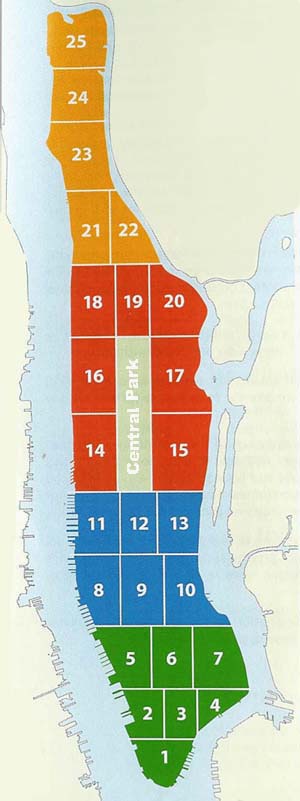
Understanding “Uptown” and “Dowtown” is easy with the right visual aid

But despite its diminutive size, Manhattan does get the lion’s share of attention, and, on any given day, it also moves the lion’s share of humanity. And by any Manhattanite’s standards, it is always overrun with visitors of two types: (a) the touristy kind, and (b) the “B&T” trashy kind (that is, those “less refined” souls who often file in over the bridges and through the tunnels from Jersey and the outer boroughs; think Snooky and The Situation). And thus anyone and just about everyone who rides the NY subway must understand the two most fundamental divisions of the Manhattan Island — Uptown vs. Downtown. “Downtown” Manhattan — the lower quarter of the island (the green part “down” at the bottom of the map to the right) — is known for the world’s most powerful financial district (Wall Street) and its eclectic, often bohemian, neighborhoods. “Uptown” Manhattan — the red part “up” around Central Park (see how that works?) — is known largely for its upscale lifestyle (think Park Avenue and the Waldorf Astoria). [The blue bit in the middle, “Midtown,” is popular as well, known for Broadway shows, Rockefeller Center, and the circus that is Times Square, among other things; while the yellow at the very top (Harlem and Washington Heights) is, for the tourist, a no-man’s land, typically not to be explored.] The Uptown-Downtown dichotomy is visible in just about every aspect of New York City life, and, for the island of Manhattan, it lies at the very heart of its underground transportation system.

The Trains:  Which way do they go?

For purposes of this discussion, this lesson in geography is important for one very simple reason: You shouldn’t board a train unless you know where it’s going. You, as a visitor, almost certainly won’t be riding that train to its final destination, but when you’re standing on the platform and the train comes rumbling into the station, it’s awfully comforting to know, before stepping aboard, that the terminus displayed atop the first car you see matches that for the train you expected to ride. Even when traveling just a few stops in central Manhattan, knowing the train’s terminal station can save you the frustration of boarding the local train when you wanted the express, or vice versa (more on that later). And when you venture out towards the ends of Manhattan (which you will do if you’re really seeing the city), understanding that not all trains on the track head to the same place is imperative.

Same track, same markings, different destinations

For example, let’s say you’ve just had lunch near the 72nd Street Station on NY’s Upper West Side (UWS for short), and you’d like to pay a quick visit to a certain Ivy League Campus, that of Columbia University, a couple of miles to the north. The first thing you need to know (which you will, because you’ve done your homework and read this article in its entirety), is that you should follow signs to the 1-2-3 lines (the red line with red circles bearing the numbers 1, 2 & 3 in the map to the left). You’ll also need to know (which you will) that you want to take an uptown train (seeing as how the trip from 72nd Street to Columbia/116th St takes you upward on the map). But what’s most important is this: The platform on which you’ll board the train has three separate lines running through it — the 1-line, the 2-line and the 3-line — the trains for which all bear circles of equal shape and color on the front. But all trains are not created equal, for if you hop on the car that comes to rest in front of you, and that car is part of a 2-train or a 3-train, you’ll find yourself headed not to the quirky collection of colleges and universities that is Morningside Heights, but instead to a quite different place altogether — to the rough & tumble neighborhood known as Harlem (3-train), or the equally rough & tumble borough that is “The Bronx” (2-train). Neither of these is a mistake you can’t correct, but they do ensure a longer and perhaps much more adventurous ride than you’d originally had in mind.

In short, I’ve given you, so far, two bits of wisdom that will ensure your relationship with the NYC Subway has a chance to succeed. Rule #1: Know your Brooklyn from your Queens and your Up from your Down. And Rule #2 (which is like unto it): Know, before you board, which train is going where.

There’s still much more to go, but at this point you have plenty to digest, and no doubt you’re itching to start your Google search for “The Five Boroughs” and dive into the NYC map. And so, for now, I’ll bid adieu with those three words that all TV fans just love to see:

… TO BE CONTINUED

~ JD

(Cover photo: My son, Philip, descending Mt. Meru, Tanzania, in the glow of early dawn, with the slopes of Mt. Kilimanjaro looming in the distance.)
A smoke-free, casino-free Vegas? … Yep.

Christine and I first visited Las Vegas in 1996, with children in tow, when our eldest was barely two and our baby was still very much a baby. It was a one-night stay, at the tail-end of a four-week road trip (half work, half vacation for me; no vacation, as it turns out, for Christine). Knowing nothing about Vegas except its Sin City reputation and looking to save a buck at the end of what had been an otherwise expensive month, I booked a $49 room at Circus Circus, primarily on the expectation that a two-story circus tent with trapeze artists would fill the two-year old with glee.

Now mind you that was 17 years ago, and I have no idea what they’ve done with the place since, but what a dump Circus Circus turned out to be! And what an awful idea that stop in Vegas was. Oh, sure, the high-flying performers did entertain the boy at times — those brief moments when we weren’t being chastised and goat-herded for bringing a kid so near the slot machines, and when we weren’t dodging and weaving the ubiquitous clouds of smoke that triggered the little guy’s asthma. But our obligatory stroll down The Strip (and I do mean “stroll,” what with us pushing a baby-buggy built for two) was more an exercise in eluding strip-club buskers than it was a sight-seeing adventure. And our room … Ugh! Long before that night was over, Christine was begging to get the hell out of dodge, and on finally getting her wish the next morning, she made it perfectly clear that she’d be thrilled never to return.

Christine's mantra for 15+ years

Christine’s mantra for 15+ years

But we have returned, on several occasions now, each of them to the soundtrack of Christine’s “I Hate Vegas!” lament, and most of them for the purpose of watching that same little boy compete in the Blackjack Invitational Gymnastics Championships as he grew into adolescence and then young adulthood. Over the years, with each visit, we would get a little wiser, learn just a bit more about how to do Vegas and, more importantly, how not to do it. We would learn, for example, that Sunday afternoon is a horrible time for the return drive to Southern California on Interstate 15, UNLESS that Sunday just happens to boast a certain big football game, in which case the person heading out of town has the freeway entirely to himself. And we would learn, too, that suffering through four hours of time-share presentation is NOT a cheap way to score show tickets (more on that another day).

But we, the foodies and theater-lovers that we are, would also discover a sliver of appeal, however thin it might be, in living just five hours from this otherwise god-forsaken town. Two slivers, actually: One, the far-Western outposts of some of Manhattan’s top eateries, like Nobu and Tao; and two, world-class entertainment from the artistic genius and athletic freakiness that is Cirque du Soleil. It is Cirque, in fact, that deserves all credit in opening Christine’s mind just wide enough to give Vegas a (fourth, sixth, eighth?) chance. But, in quite a surprise turn, it is a grand new experiment in the Vegas hotel scene that might finally have sealed the deal on her acceptance of Sin City as a legitimate destination, for at least a two or three-day stay.

This story really begins at Christmastime 2011, when I treated Christine and her parents to a weekend getaway at the Aria Hotel & Casino, complete with tickets to see the Cirque show “Viva Elvis” that was running at that time. (Elvis is very much their thing, and equally so not mine, and so I was happy to take one for the team and sit out the weekend to give Christine and her parents some quality time together over the holidays.) Christine enjoyed the show, to be sure, but what brought her home raving was Aria, with its über-contemporary, meticulously clean, and extraordinarily comfortable accommodations. She carried on and on about the place, that I would love it and must stay there some day. Oh, she still hated the smoke and despised the cacophony of the casino, but these newer hotels were doing a good job of masking the former, and she had been able to skirt, or at least selectively mute, the latter. It became clear immediately that, while Christine certainly hadn’t been bitten by the Vegas bug, she had made peace with Sin City; she could finally see that an occasional urge to visit might not be a sign of insanity after all.

And so, after allowing some time to go by, I dared plan a return trip to The Strip, under no guise, for no purpose other than to enjoy much of what makes Vegas Vegas. I knew that, for that bold an endeavor, I had one shot to get it right, one shot to show Christine a Vegas so attractive that she’d have no choice but to concede that she’d had fun and might enjoy going back again. So I began stewing — stewing and brewing — in hopes of devising the perfect plan. And the perfect plan I did hatch. Well, I really should say … we did hatch. “We” would include one of Christine’s dearest friends, a friend who had, not too long before, suggested that we all should get away to Vegas some day. A friend who had already planted the seed that a return trip to Vegas — sans kids and sans parents — was something Christine needed. A friend who gave me the perfect in-road to test the Vegas waters.

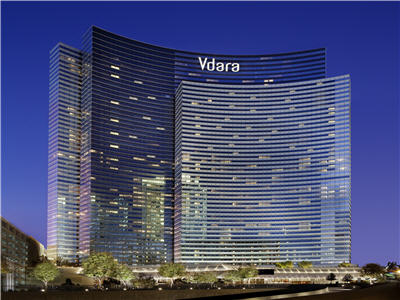
And so this friend and I worked together to choose the perfect dates on the calendar (my birthday weekend, of course); to assemble the perfect entertainment itinerary (ample time by the pool for my sun-worshiping wife, of course); and to find and book the perfect hotel (a challenge for which Christine had already given me a head-start, of course). I needed little time with my head in Vegas.com search results and TripAdvisor reviews before discovering that Aria has a very beautiful step-sister, one who answers to the name Vdara.

Vdara Hotel & Spa

Vdara Hotel & Spa on the Las Vegas Strip

Vdara Hotel & Spa. A 57-story, all-suite luxury hotel that opened adjacent the Aria in December 2009. A luxury hotel in which the smallest rooms (the “Deluxe Suites”) weigh in at 550 square-feet apiece, each with king bed, a sofa & two comfy chairs, a cooktop kitchenette (with microwave & mini-fridge), and a breakfast nook built for two … all for the decidedly non-luxury price of $119 per night, Sunday through Thursday, even during the peak gambling season of March Madness. Another $100 per night scores a veritable condominium — the 820 square-foot “Panoramic Suite,” with more complete kitchenette, larger living and dining areas, and a 270-degree view of The Strip and the city around you. And first-time visitors who book two of these suites just might find themselves upgraded to the “Hospitality Suite” (oh, yes, they just might), which boasts over 1600 square-feet of space, including two large bedrooms with dual master baths, full kitchen and living area, and a dining table that easily accommodates six people.

The 820 square-foot Panoramic Suite

But, wait. I haven’t gotten to the good stuff yet. I haven’t mentioned the one … no, make that two … features that make Vdara the PERFECT hotel for my “Vegas-hating” wife.

  • NO CASINO
  • NO SMOKE

No joke! Vdara is one of only two smoke-free, casino-free properties in the Vegas City Center, and it is the only one of the two that offers rooms at anything less than $250 per night (and, at $119, a far cry less at that!). Apart from the one evening we spent in a club, I’m not sure I smelled a single waft of smoke the entire four-day weekend. And the only casino I saw was the one I purposely sought out (Casino Royale, next to The Venetian — the only $5 Blackjack tables I’ve found on the The Strip). Even our field trip to the Aria, to see the newest Cirque production Zarkana, had us riding an escalator to the mezzanine level before we were even so much as within earshot of the casino bells and whistles.

To say the trip was a success would be a tad modest. Perhaps Christine would say that I’m overselling her enjoyment of the weekend; but, then, our friend would probably tell you that I’m underselling it. I know this: Christine had fun. I had fun. We all had fun, and we were all simply “blown away” at the quality, the luxury, the spaciousness, the cleanliness of Vdara, especially at the price we were paying. And, most importantly, Christine can no longer say that the things she hates most about Vegas are the smoke and the casinos. Because this Vegas — her Vegas — has neither smoke nor casinos.

~ JD

(Cover photo: My son, Philip, descending Mt. Meru, Tanzania, in the glow of early dawn, with the slopes of Mt. Kilimanjaro looming in the distance.)
Everyone loves (or should love!) a one-night stand

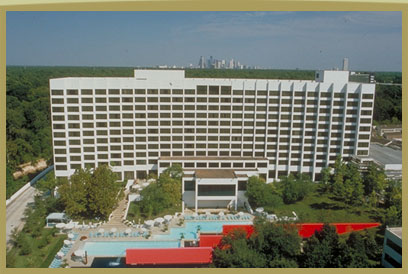
Very early in my professional career, I was fortunate to land a good job in an office building located in what is one of the few truly “beautiful” parts of the city of Houston – a quiet little area tucked away at the corner of Woodway Drive and S. Post Oak Lane, just off the so-called West Loop, at the edge of the heavily-wooded Memorial Park, literally a stone’s throw (heck, within spitting distance from my 12th floor office) of the home to which George H. W. Bush retired upon leaving the White House. This corner is also home to Houston’s Omni Hotel, a structure whose east-facing rooms (those above a certain floor, anyway) have a very pretty view across the park, right along the treeline – a sea of green to the downtown skyscrapers in the distance. I never had the opportunity to watch the sunrise there, but my guess is that, if you were going to make a point of waking early enough to see sun’s dawn over Houston, this would be one of the very few places worth doing so.

Houston Omni

The Omni Hotel, Houston

The Omni treated its office-park neighbors very well then, offering rooms at some 40-50% off its normal rates. Christine and I, brand new parents at the time to two kids under the age of two and living in the ‘burbs some 40 minutes away, attended many a professional event at the Omni. Knowing the kids were in great hands with my parents, I would suggest every time, without fail, that we rent a room there and enjoy an inexpensive night away. And every time, without fail, Christine would say, “That just doesn’t make sense; why would we pay to stay in a hotel when we can sleep at home for free!?!” I could think of at least two diaper-clad reasons why, but in my five years in that job, I never won that battle.

I’m happy to report, however, that over the 15 years since, all of them in San Diego, Christine has come to see the beauty in my madness. Why does it make sense that “vacation” – time away from the chores and the grind of daily life – must entail spending hundreds or even thousands of dollars on airfare, or driving thousands of miles to some remote part of the country? If I can arrange a blissful night or two away from home for just a couple hundred dollars and a 50-mile round-trip drive, why shouldn’t I? And with that logic, for us, here in the city of San Diego, the mini-vacation – what I like to call the “one-night stand” – was born. (Note: I often hear the term “staycation” as a reference to stay-at-home “vacations,” but I sense that common usage of this term too often entails staying, quite literally, at home – sleeping in one’s own bed, burning vacations days to tend to life’s normal duties and only then, in the unlikely event that any time remains, getting out and enjoying the treasures of one’s home town. While this type of “time away” has its place and can be rejuvenating in its own right, it is NOT what I am advocating here.)

For C and me, one-night stands come in a variety of forms – after a night of baseball and dancing downtown, after a concert or some other live event, for a birthday or anniversary or other special occasion, or sometimes just because the timing and the price are right. Quite often, we’ll take advantage of one of the social-media discounters (Groupon, Living Social, etc.) to check out a new or newly renovated hotel in a hip or quirky part of town. Sometimes we stay downtown just because that’s where the action is. Sometimes we head outside the city to enjoy the ruggedness of the Southern California terrain, or the magic juices of SoCal wine country, or both at the same time. The point is this – making time for two or three of these quick local getaways a year has breathed warm new life into our relationship, and it makes us fall in love over and over again with this cool little hamlet we’ve chosen to call home.

But enough about us. You want to hear about one-night stands and how to plan them. That’s easy. If you have no kids, or if your kids are grown or nearly grown, you’re golden. Just plan a night away, now. Right this very minute. Don’t delay. Hop on Groupon Getaways or Living Social Escapes or TripAdvisor or Orbitz or Travelocity and find a hotel in some nearby neighborhood that you’ve always wanted to explore but just never have. If you have kids that need overnight care, then call in a favor from your best friend, or call your parents or your brother or sister, and arrange for a night or two away. If you’ve never tried it, you’ll be surprised at how accommodating people are. Then book a place that forces you to get to a part of town you’ve never really discovered and do things that you never really do, or haven’t done in a very long time.

And when you get there, go out for a stroll and enjoy what the immediate neighborhood has to offer. Grab dinner in an eatery that has the locals all abuzz (Zagat or Yelp will help you find one). Catch some live music, cut the rug, or belt a karaoke tune (or two) at a nearby bar. Stay up late and, of course, sleep in. Order up room service for brunch or, better yet, skip it and make a detour to some other part of town for lunch at a hotspot diner before heading back home.

A night like this is tremendously refreshing, and it’s a great way to experience your home town with the wide-open eyes of a tourist or visitor.  Do it enough, and you’ll discover some pretty cool places, maybe even learn a bit of local history that you didn’t know existed. Who knows … you might just uncover gems like these.

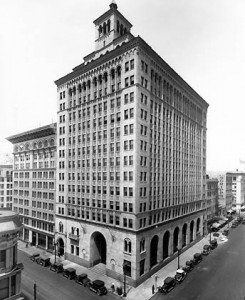
Courtyard Downtown - Old

The original San Diego Trust & Savings Bank building, circa 1930, now home to the Courtyard Marriott SD Downtown

Courtyard Marriott San Diego Downtown: The Courtyard in downtown SD is one of the coolest hotels I’ve ever seen, bar none. Located at the corner of Broadway and 6th Avenue, in the heart of downtown and at the doorstep of the historic (and very lively!) Gaslamp District, the Courtyard resides in the exquisitely restored San Diego Trust & Savings Bank building, constructed in 1927 in the Italian-Romanesque style, an architectural tribute to the churches of the Middle Ages. The two-story lobby boasts columns made from 19 types of Mediterranean marble and intricate, colorful stencil-work detail on the ceiling. The hotel’s front “desk” is a marble teller station, where its service reps are happy to help with your room-key withdrawal in exchange for a cash (or credit) deposit. And then there are the guest rooms – each a former executive office or meeting room with more than enough space to stretch your legs with a cartwheel or two. If you like live music, the House of Blues is right next door; to wet your whistle and twist, shake, grind, break, the Gaslamp offers countless bars and clubs; for baseball fans, Petco Park and the SD Padres are just blocks away for much of the year; and for those who like to get their freak on, Larry Flint’s not-so-subtle retail shop is just down the street. In off-season (to the extent there is such a thing in SD), I’ve seen room rates as low as $109 for this now-not-so-hidden gem. Nevermind the Hotel Del and L’Auberge Del Mar – when it comes to bang for the buck, the Courtyard Downtown is a true San Diego treasure.

Courtyard Downtown

The restored marble & stencil-work ceiling in the lobby of the Courtyard San Diego Downtown

MINOLTA DIGITAL CAMERA

The Johnny Weissmuller pool at The Lafayette Hotel, San Diego

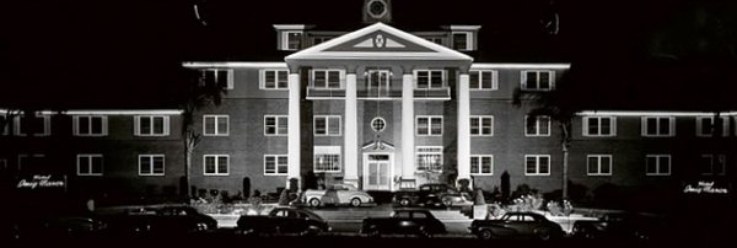
The Lafayette Hotel, Swim Club & Bungalows: Built along “The Boulevard” (El Cajon Blvd, CA Hwy 80) in 1946 during its heyday as a San Diego thoroughfare, The Lafayette (also known as Imig Manor, for its founder and original owner) flourished in the 40’s and 50’s as a resort getaway for Hollywood’s elite, counting chief SD-phile Bob Hope among its greatest fans. With its Grand Colonial design and spacious guest rooms, suites and bungalow apartments, The Lafayette quickly became one of SD’s hottest attractions. Its spectacular swimming pool – meticulously preserved over its 60+ years – is itself a celebrity, designed by five-time Olympic gold medalist and original big-screen Tarzan, Johnny Weissmuller. After undergoing dramatic changes at the hands of the Hiltons in the 1960’s and falling into disrepair in the decades that followed, The Lafayette underwent a thorough, $6M renovation in 2011 & 2012 that has restored most, if not all, of its glory-years charm.  With rooms often priced as low as $69 and rarely over $109 – including those that open directly to the pool deck – and with its location barely 10 minutes by foot from the hot University Heights and North Park neighborhoods and 10 minutes by cab from downtown nightlife, The Lafayette is hands-down my best hotel find in San Diego, and quite possibly the best in any city. I’m so enamored of this hotel, in fact, that it’s with great hesitation that I write about it at all, for fear that its stock will rise too quickly as it’s discovered for the gem it is.

Lafayette - Old

The Lafayette Hotel, circa late 1940’s

Tower 23

Tower 23 Hotel, Pacific Beach

Tower 23:  Named for the Pacific Beach lifeguard tower over which it stands, Tower 23 is less about bargain and more about elegant, comfortable, contemporary design and an enviable bluffside location in San Diego’s hippest and most classic beach community. Despite its name, with only 44 units – all ocean-view – in a three-story layout, this hotel towers over nothing except its modern-chic hotel peers. Its restaurant and bar, JRDN, serves up fresh handmade cocktails and quirky-fun California surf & turf cuisine that are second to none. Tower 23 can be pricey if you let it, but it also offers fantastic specials – like “Sex on the Beach,” with surfside room, dinner and breakfast for two, and in-room couples massage, all for less than $300 – and it occasionally plays in the Groupon space with dinner & room deals at barely half the cost of a regular-price booking. Tower 23 isn’t one you’re likely to do often, but it is one that you must do at least once.

At this point I’ll concede that my discovery of San Diego’s one-night-stand scene is still in its infancy. No doubt I’ll find many more local havens to love in the coming years, and no doubt many of you already have. Please share your stories with me. And, by all means, don’t limit it to San Diego. As I’ve said repeatedly in this forum already, I love to travel, and travel loves me. No matter where you live, please share your favorite one-night-stand-worthy locations as well.

~ JD

(Cover photo: My son, Philip, descending Mt. Meru, Tanzania, in the glow of early dawn, with the slopes of Mt. Kilimanjaro looming in the distance.)
Why rent a room when you can have the whole house?

Back in the day, I had a one-track mind. (No, not THAT track! Although, as a man, I must admit that track does play pretty often.) Every time we’d travel, the first thing I’d do after securing our flights or plotting our route on interstates was book hotel rooms. For years, hotels were all we knew. The brand names grew nicer over time — Motel 6 and Super 8 at first; then La Quinta and Ramada Inn; Hyatt Place and DoubleTree Suites; and, eventually, roomier and comfier boutiques — but always hotels. When the kids were little, this worked very well. They didn’t take up much room, and we needed them close to us. But as they grew, and as those teenage attitudes began to set in, a double bed for the two of them no longer did the trick. (Heck, even a California King is too small for siblings reluctant to share a space.) At the very least, we needed two beds and a hideaway sofa. But, of course, that always bred a feud as well. (“I get the bed.” “Nuh-uh, you got it last time; you take the sofa!”) So, more often than not, we found ourselves with two rooms, at least three beds, and a price tag now double what we had come to expect, with little gain in comfort to show for it.

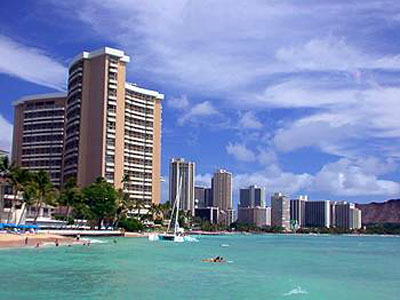
The Sheraton Waikiki Beach, Honolulu, Hawaii

Enter Hawaii. 2007. My son, then just shy of 13, had qualified for the regional gymnastics championships in Honolulu. My daughter, having just turned 11, was happy to tag along for the ride. As good gymnastics parents do, we booked the nicest room we could in the USAG’s discounted hotel block — upper-floor, with balcony and a decent view, at the Sheraton Waikiki — and set out on our maiden voyage to the Aloha State. The hotel was nice enough, but we learned very quickly that we really didn’t want to spend much time in Honolulu, let alone the über-touristy Waikiki Beach, so we set out each day to discover new, and much more interesting, parts of Oahu. The trip was a raging success — due mostly to Oahu’s beauty and boundless activities — but the one drag day-in, day-out was having to trudge back to a high-rise hotel (as nice as it was) and cram ourselves and our not-so-little tweens into a space built (at best!) for two.

As it turns out, Christine and I would be back in Hawaii — this time Kauai — barely eight months later for a buddy’s wedding. While exploring Oahu earlier in the year, we noticed that the island, outside of Honolulu, was chock full of houses and condos for rent to vacationers. Not wanting to repeat the Hawaii hotel experience in Kauai, we decided to find a condo instead, and we discovered Outrigger.com. Run more like a hotel for purposes of booking and check-in, but with properties that are decidedly condo in construction, Outrigger gives travelers a much more spacious and comfortable lodging experience at only slightly, if any, more cost than a hotel of similar quality. For our destination wedding in Kauai over the New Year holiday, rooms at the Grand Hyatt in Poipu (the host hotel) started (and I mean started!) at more than $400 per night. And that price didn’t buy you a suite, just a standard King room, and one with no view at that. Of course, the Grand Hyatt is a compound of the utmost luxury — high walls and pristine grounds that ensure its guests are in complete isolation from the world outside. Large families with bored, screaming kids might be trapped inside, but that’s just minor annoyance when you’re lying on a freshly combed beach with $15 mai-tai in-hand. Right?

Outrigger Kiahuna Plantation, Kauai, Hawaii

For some people, many of them my friends, that’s a vacation. Not for me. When I travel, I want to experience my destination, all of it, the good and the not-quite-so. I expect my health and safety to remain intact, of course, but in lodging I seek a clean, comfortable place that only thinly veils the grit and the flavor that make my destination worth visiting in the first place. On Kauai, that place was the Outrigger Kiahuna Plantation, a condo complex just steps from the beach and (better yet) from “downtown” Poipu and Brennecke’s Beach Broiler, home of mai-tais that are far too good and too cheap for my liver and my waistline.

At Kiahuna Plantation, Christine and I found a spacious one-bedroom condo with an en-suite kitchen, an enormous living area that gave way to a comfortable patio, and walls full of windows we could cast open to enjoy the sound and the feel of Kauai’s soft winter rains. Kiahuna was our first vacation-rental experience, and for almost a week, it was our little Kauai “home.” The cost to us was $249 a night, during what I’m told is the single most expensive time of year — the week between Christmas and New Years — in Hawaii. We loved everything about that stay in Poipu, and while we have not yet had occasion to go back, we know precisely where we’ll stay when we do.

Since then, the vacation rental has become our norm. Hotels still have a place in our life, to be sure — when it’s just the two of us for a short visit, or when we’re hopping from site to site along the interstate a night or two at a time, or when the culture and personality of the destination dictates, a hotel can be just what the doctor orders. But for much, if not most, of the travel we do these days, vacation rentals are a classic “no brainer,” giving so much more bang — room, comfort, convenience — for the buck that hotels don’t even enter the conversation as we search for places to stay. A few stories to illustrate:

Spring Training, Surprise, Arizona: A life-long baseball fanatic living 15 years in Southern California, I’m ashamed to admit that I have yet to attend a Cactus League game. But a nudge from my parents soon will change that, as we (five of us, including my teenage daughter) will meet up in Surprise, Arizona, for a few days of late-winter baseball. My parents, very much the types drawn to the comfort of the known, were set on a particular hotel … the Holiday Inn Express in Surprise. Fortunately, with minimal convincing, they were swayed to consider a rental property instead: “I bet I can find a three-bedroom house with spacious living area for less money than two rooms at the Holiday Inn Express. Would you go for that?” … “But we want to stay in Surprise!” … “No worries, I’ll only search in Surprise.” … “Deal!

Spring Baseball! Rental house in Surprise, AZ, Cactus League home of the Texas Rangers.
(Click photo to enlarge)

And so it was that we found (through www.VRBO.com) this four-bedroom, two-bath house with heated saltwater swimming pool and 55-inch flat-screen TV just four miles from Surprise Stadium. Our grand total (including taxes and cleaning fees) is $265 per night … just $132.50 per family, all-in! My parents were immediately sold, but just for grins, I decided to search rooms at the Holiday Inn Express for the dates of our stay. It was already booked up. For the entire month! Finally, I found a few days with availability three weeks before our visit — before Spring Training even begins. The rate: $159 a night. Plus tax. Per room. More than $330 per night for two cramped rooms. So, not only will we be staying in 1500 square feet of four-bedroom bliss, we’ll be SAVING at least $65 per night between us! As I said above, a “no brainer.”

Lake Wanaka (and the town of Wanaka, right) from several thousand feet
(Click photo to enlarge)

Wanaka, New Zealand: My family’s “trip of a lifetime” happened this past summer, when we visited New Zealand and Fiji as a final “grand hurrah” before sending the elder kid off to college. We made many stops along the way and enjoyed every single one of them, but the one we most anticipated, by far, was the five-night stay in South Island ski country, in the small but bustling hamlet of Wanaka, situated at the eastern edge of the Southern Alps on beautiful Lake Wanaka. On a tip from the friend of a Kiwi friend, we scoured dozens of listings on BookaBach (www.BookaBach.co.nz; “bach” being the En-Zed term for a vacation property), ultimately choosing a newly constructed, three-bedroom, two-bath gem at 66 Mt. Iron Drive. The house had a beautiful contemporary kitchen (where we cooked breakfast and dinners most days), a spacious living area (where we watched the Lord of the Rings trilogy in its entirety after skiing over the course of three days), and heated tile floors throughout (a very nice touch in the dead of Kiwi winter). The price for all this luxury: $210 per night (US currency), including all taxes and fees.

Our sunrise view before hitting the slopes in Wanaka, New Zealand
(Click photo to enlarge)

Tipsy croquet at a Central Coast property
(Click photo to enlarge)

Paso Robles / San Luis Obispo, California: A couple of years ago we did a combined college-tour and wine-tasting trip to the California Central Coast, with four families (13 people total) sharing a four-bedroom, 2.5-bath house in rural Atascadero (found through VRBO.com). After a day of winery-hopping or campus-strolling, we’d cook our own dinners and wind down with a game of croquet or touch football in the spacious yard under the late-afternoon California sun. Split among the four families, this place cost us $135 per night apiece, all-in.

I could go on for hours and hours, pages and pages, talking about the two-bedroom condo just a two-minute walk from the lifts of Snow Summit, or the four-bedroom house shared with three other couples on the slopes of Deer Valley, Utah, or the two-bedroom townhome at the dunes of Pismo Beach, or the five-bedroom ranch house perched atop a hill in California wine country, or …. But I won’t. You get the gist. Thinking, quite literally, outside the run-of-the-mill-hotel box will transform your vacation experience, allowing you to “live” in your destination as though you belong there, as though, for a short period, it’s your very own home.

On your next vacation away from home (and I’ll talk another day about stay-at-home vacations), don’t be content with booking a room. Book the whole house!

~ JD

(Cover photo: My son, Philip, descending Mt. Meru, Tanzania, in the glow of early dawn, with the slopes of Mt. Kilimanjaro looming in the distance.)

First things first: TripAdvisor is the DIY planner’s best friend!

Before I ever set out on this writing adventure, I had two-dozen topics of conversation in mind, enough that one might think I’d have a heck of a time deciding where to begin. I didn’t. Of all the travel secrets I’ve picked up over the years, for a self-planner like me, one stands above all … TripAdvisor is the Do-It-Yourself Travel Agency’s best friend!

When planning time away from home, the most important choice you’ll make, bar none, is where to lay your head each night. Yes, you read that right. For every trip you take, the most critical decision lies not in selecting the destination of your travel, but where you’ll be sleeping once you get there. Now don’t get me wrong; destination is certainly key — Iceland’s no good when you fancy the tropics, and you will, after all, need to know which plane to board at the airport. To be sure, your destination will likely be settled well before you ever begin the trip-planning process. But it’s not the traveler’s most important decision, not by a long shot. No matter where you go (except maybe Vegas), if you can’t get a decent night’s sleep in a clean, comfortable room along the way, you will not have a good time. You might enjoy much of what you do with your days, but you won’t look back on the experience with warmth and fondness down the road. And for some trips (like the resort vacation Christine and I recently took to Fiji), the lodging IS the destination, the very reason for selecting the particular city or island or country for your visit.

For many people, some of them my closest friends, lodging is never an issue. They know precisely where they’re staying every time they leave home — in a Hyatt, or a J.W. Marriott, or a DoubleTree — and this is fine. It’s a perfectly legitimate, and safe, way to travel. But for some of us, particularly me, and particularly when there are more than two travelers involved, those options are unsatisfying at best, and quite often they’re prohibitively expensive. Parents in one double bed and children in another is just fine when the kids still need help going to the bathroom. But when they’re teenagers? And six-feet tall? When mom & dad (or mom & mom, or dad & dad) would really like some time alone? In these moments, the “whole family in a hotel room” thing just doesn’t work. That room becomes two rooms. Double the price. And for a brand-name chain, particularly one in an entertainment mecca like NYC or Chicago or San Francisco, this can be prohibitively expensive. Or, perhaps, in a culture-rich city like New York, where every neighborhood has a distinct personality and its own attractions, the marquees bearing the logos you recognize are simply in the wrong part of town. You’d rather be on the Upper West Side or in Greenwich Village than in East Midtown or (god forbid!) Times Square. Or else, as is the case for some of us, the name brand is simply … unsatisfying. The rooms are too sterile, too generic, too devoid of the charm and culture that attracted us to this destination in the first place.

Sometimes, you just need to be creative in your lodging selection. But as you step away from the familiar, how on earth do you know what you’ll get? In a sea of boutiques, how do you know which one to choose? That, my friend, is where TripAdvisor comes in!

TripAdvisor (or, more appropriately, TripAdvisor.com) is an online travel-planning resource like no other. Set up to help research and book just about every aspect of a travel itinerary (from hotels to flights to restaurants to entertainment), TripAdvisor is particularly useful as a source of open, honest and often cutting insight into the quality of the places to stay. I use a wide variety of resources in searching the universe of available room & board for each trip I plan (more on that another day), but I ALWAYS turn to TripAdvisor — and particularly to the reviews submitted by its users — before zeroing in on a lodging choice.

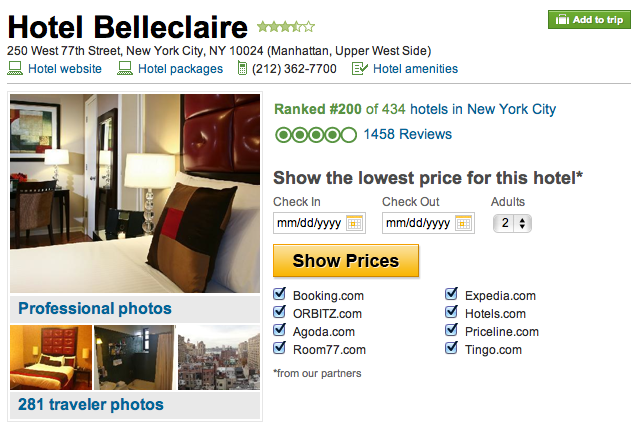
To illustrate, let’s look at one hotel in particular that hit my radar for an upcoming college visit to NYC. Hotel Belleclaire is a boutique hotel on New York’s Upper West Side, just a short walk from Lincoln Center, that turned up in a search I ran on another favorite site, Quikbook.com (again, more on that another day). Searching only for hotels in certain parts of town, as well as those with quarters large enough to afford my nearly-adult daughter her own sleeping space, I spotted Hotel Belleclaire on the list, sporting a price significantly lower than its peers. Why might this be? What skeletons might lie in the closets? What ghosts might drive me away? Or, on the other hand, what amenities or unheralded qualities might reward me for choosing this place?

Screen Shot 2013-01-10 at 9.31.28 PM

TripAdvisor profile for Hotel Belleclaire in NYC’s Upper West Side (click to enlarge)

As you see in the graphic to the right, the TripAdvisor profile for Hotel Belleclaire lists it at 3.5 stars on the luxury scale with an overall rating (from almost 1500 reviewers) of right at four stars (out of five). It also shows that, per TripAdvisor’s review-weighting algorithm, the Belleclaire ranks 200th out of 434 New York hotels in the TripAdvisor database. So, middle of the pack. But what does that mean? How do I make anything of that ranking? I already know the place offers the right type of room in the right part of town at a price that beats just about all others. If I choose this property, how can I have any idea what type of experience I’ll get for my money?

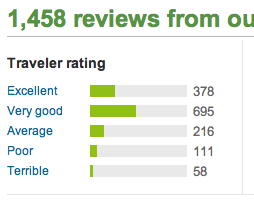
Screen Shot 2013-01-10 at 9.58.24 PM

User ratings for the Belleclaire

Cue the user reviews. Notice here that more than two-thirds of all reviewers (over 1000 of them) gave the Belleclaire an “excellent” or “very good” rating. But notice, too, that 58 people had experiences so bad that they gave only one star (“terrible”), and a hundred more rated their experiences as “poor.” Why? What’s the story? What left these people so turned off? THIS is where I always start my investigation … with a quick perusal of the property’s one-star reviews.

In browsing the user comments, I focus on just a few things: (1) What precisely is the reviewer’s complaint (or the compliment, in the case of a good review); (2) is it an issue of any importance to me; (3) what is the date on which the review was written; (4) are there more recent reviews to indicate that the problem (or strength) has disappeared? Quite often, the negative reviews carry the day in nixing an otherwise well-rated hotel — the complaints hint at on-going problems that could ruin my trip, like paper-thin walls, or long-term construction, or space that is more cramped than the gloss led me to believe.

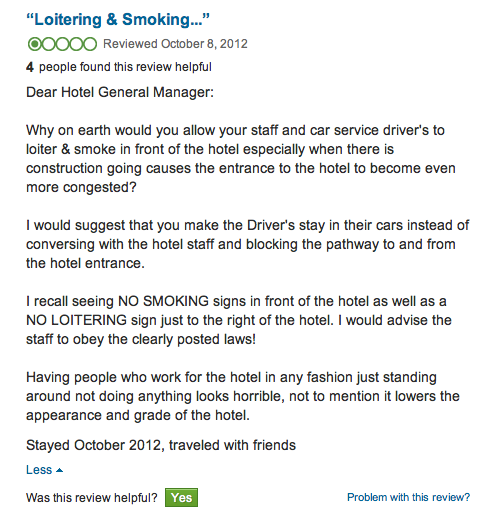
Screen Shot 2013-01-10 at 8.09.46 AM

This 1-star reviewer won’t tolerate cabbies who smoke and “loiter”

From time to time, the negative reviews have also been the very things that sealed my decision to STAY at a particular place — such as those I read several years ago, when looking for a romantic weekend getaway without the kids, that lambasted the hotel as being a horrible place for families with small children. (“What? Not a place for children? Yes!!!”)

Here you see one of the “terrible” reviews for Hotel Belleclaire. A one-star rating. What disastrous conditions did the reviewer encounter? Just one … a gaggle of limo and taxi drivers smoking cigarettes on the sidewalk outside the hotel’s entry way. Unsightly? Sure. A deal-breaker for me? Never.

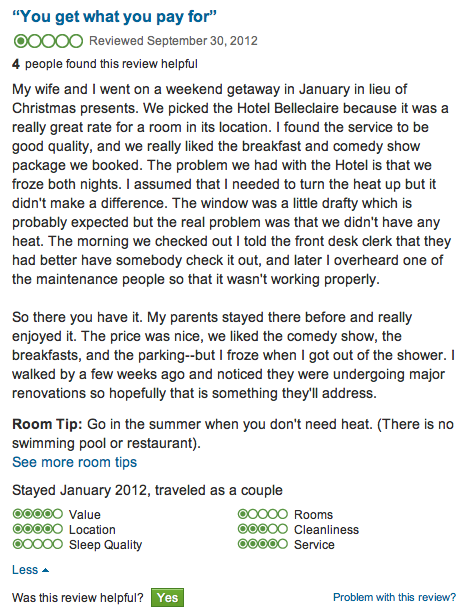
Screen Shot 2013-01-10 at 8.15.23 AM

And here’s another of the Belleclaire’s one-star reviews. What did this guest have to say? That the hotel offered “a really great rate for a room in its location.” That the service was “good quality.” That he “really liked the breakfast” and enjoyed the comedy show package booked through the hotel. That his “parents stayed there before and really enjoyed it.” Hmmmm …… So what was the problem? Why such a poor rating? Apparently he “froze” (in January) while getting out of the shower. Um-kay. Cold and shrunken parts are no doubt a source of discomfort and frustration, but enough to keep me away? During an April visit? No way.

Screen Shot 2013-01-10 at 8.20.35 AM

Positive reviews often reveal that temporary problems are gone, while some show that many complaints are directed at the destination itself and not the hotel

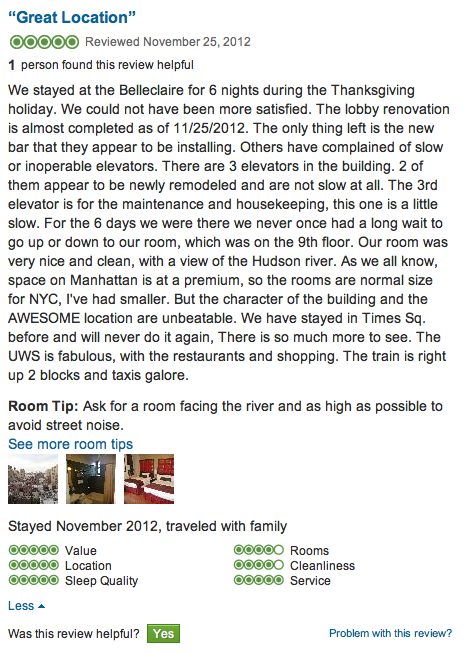
In addition, quite a few recent reviewers of the Belleclaire complained of remodel construction that made the place loud and unsightly during their stays. A very legitimate concern, and one that perks my ears. That’s where I turn to the positive reviews, particularly the recent ones, to see what the satisfied customers have to say. And there I find this five-star review, written after a visit just six weeks ago: “The lobby renovation is almost completed; the only thing left is the bar. Our room was very nice and clean. The character of the building and the AWESOME location are unbeatable.” Other recent reviews confirm that the remodel is finished, and many challenge the legitimacy of other complaints, such as those about room size (smaller rooms are the norm in NYC) and road noise (some of which is unavoidable in The Big Apple, or in any big city for that matter).

So, despite a fair number of bad reviews and poor ratings, I have found what might be the perfect boutique for our upcoming trip to New York City. The price, location, amenities and positive reviews (which in this case seem much more familiar with NYC as a destination) win the day. And TripAdvisor, once again, has provided all the advice I needed in making my hotel selection.

~ JD

(Cover photo: My son, Philip, descending Mt. Meru, Tanzania, in the glow of early dawn, with the slopes of Mt. Kilimanjaro looming in the distance.)
I love to travel. And I love to plan it.

I love travel. Travel loves me. Some say I have been bitten by a nasty bug, one that has infected me with a severe, incurable case of wanderlust. They would be right.

My wife often comments (laments?) to friends: “He can’t take any trip unless the next one’s planned too.” She’s wrong about that; or at least she’s much too modest. It’s a rare day, you see, when I embark on any journey without having two more lined up behind it.

And that’s the way it should be! I love to travel. And I love planning trips. Myself. Every gritty detail. From flights to ground transportation to lodging to meals to entertainment to meet-ups with family and friends. And over the years, I’ve gotten pretty good at it. I’ve become adventurous in the planning. Twenty years ago, when we had little money, it was Super 8’s and Motel 6’s all the time, because that’s what we knew. They were cheap, and there was comfort in the known. Then it became La Quintas and Residence Inns. Holiday Inn Expresses. Nicer, but still known. Still safe. When feeling peckish, or when business travel would allow, I’d kick it up a rung or two — the Omni, a Hyatt, or even a Ritz-Carlton. But still ….

An inn with a view: Mts. Cook & Tasman from the Mt. Cook View Motel, Fox Glacier, New Zealand

Today, the approach is different. The horizon is expanded. The appetite for risk and adventure is much greater. And the reward is oh-so-much richer. A two bedroom townhome on the shores of Southern California with my wife and kids; a five-bedroom house on the slopes of Park City with a large group of friends; a three-bedroom house on New Zealand’s South Island; a two-bedroom apartment on New York’s Upper West Side. I have learned, through some initiative of my own and the suggestions of friends, and with the help of a vast array of online resources, that the (eminently affordable!) alternatives to the middle-American hum-drum of chain hotels (and chain eateries, and chain entertainment parks, etc, etc, etc) are limitless and full of reward for those daring enough to step off the road most traveled.

In the coming months, perhaps even years (we’ll see how this goes!), I will share my own anecdotes, my experiences, my “secrets,” the tools of my trip-planning “trade.” I’ll share the things that I’ve learned — and continue to learn today — that have transformed my business and vacation travels into full-on adventures. I’ll share stories from exotic lands, places that most would consider never-in-a-lifetime destinations, yet places that everyone with just a little industriousness and a healthy sense of adventure can (and should!) visit. I’ll show you how you too can get there and how to go about filling out your days once you do. I’ll also share stories of weekend getaways, of cross-country family reunions, of breathtaking sunrises and stunning sunsets, of gems so hidden that they’re right beneath your nose, of inexpensive meals that will send you into fits of culinary ecstasy.

But most importantly, I will show you how I do all of this for myself. How I find the right flights to the right cities at the right time for the right fares. How I find clean, comfortable living spaces in cool parts of town for no more than the cost of a basic hotel room. How I maneuver through the crammed streets of the world’s largest cities one day, and then wander the wide open spaces of its most expansive countrysides the next. On occasion I will show you how to save money when you travel, but far more often, I’ll show you how to do and see and experience so much more on the money you’d plan to spend anyway.

Again, I’m no expert. I’m just a guy. And it might be that, in the end, I’m blogging for myself. My hope, though, is that by sharing what I’ve learned through my love of travel and trip planning, I’ll inspire you to think bigger, bolder and much more adventurous when you next leave home.

~ JD

(Cover photo: My son, Philip, descending Mt. Meru, Tanzania, in the glow of early dawn, with the slopes of Mt. Kilimanjaro looming in the distance.)